AwareofAware

Evolving news on the science, writing and thinking about Near Death Experiences (NDEs)

Do Rats Have NDEs?

Apologies for the weird image, but this was my first attempt at using AI!

This study looks at what happens to rat brains around the time of death.
The main difference between this and the previous (infamous) rat study published by Borjigin in 2013 is that it analyses what happens through different layers of the brain to see if activity occurs at deeper levels for differing periods of time. The short answer to the question of whether there are differences is that for the most part, and in terms of differences that would be important to our area of interest – conscious activity – there are no major distinguishable differences in the timings and nature of initial activity in the different layers of brain immediately after death.
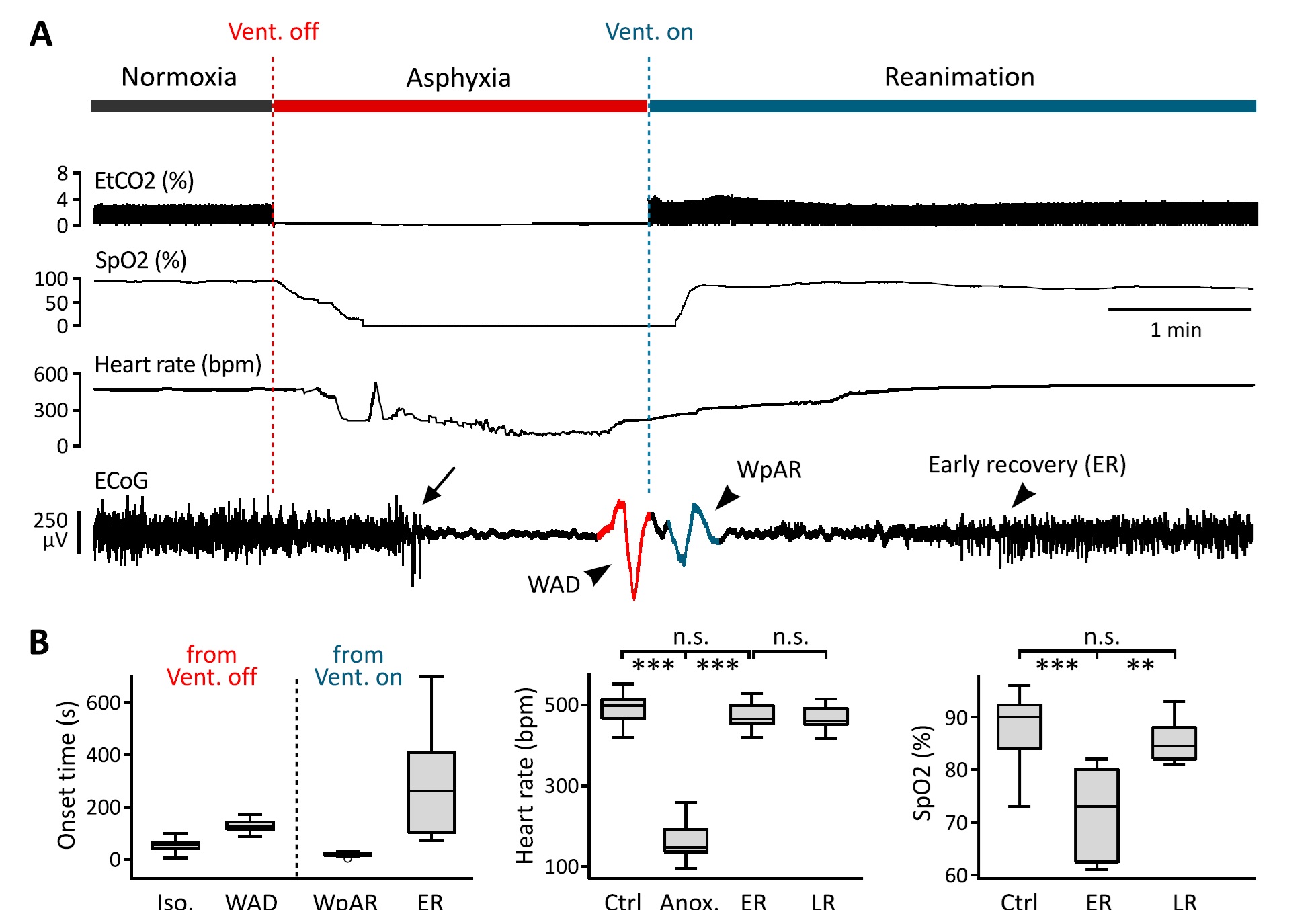
The diagram shows the rough timings with ECoG vs heart rate and blood oxygen levels (SpO2). ECoG (electrocorticogram) is invasive and uses probes that penetrate the exposed surface of the brain, as opposed to EEG – (electroencephalogram) which uses sensors placed on the scalp. This enables the study to identify electrical activity deeper in the brain.

What we see is that about 30 seconds after the removal of oxygen the heartbeat slows quickly to about 10% of its normal rate, then within about another 30 seconds normal brain activity ceases and the ECoG flatlines or becomes “isoelectric”. During this 30 seconds after CA it is plausible that conscious activity could occur. This is the claim made in the Bojigin study that got the materialist community so excited since it could be argued that NDEs occurred during this period. This paper references that discussion without asserting any new conclusions, or indeed using the findings from this study to confirm those conclusions. They have nothing to say about rats having NDEs. Well done, that is good science.

About a minute after brain activity has stopped, brain cells (neurons) undergo depolarisation (WAD). This basically means the cells move to a a non-functional, but recoverable state. Prior to this they are in a state of readiness and functional, but are not functioning. During this wave of depolarisation there is a slow wave electrical signal. This is not associated with conscious activity and is just a marker of the change in electrical state of the brain. Unlike the initial activity, this wave is not synchronous across all layers, i.e. it occurs like a wave spreading across the layers. Resuming the flow of oxygen allows for the brain to slowly recover activity.

Other than showing that the changes in brain activity that occur immediately after death are uniform through all layers of the brain, they also demonstrated that subsequent depolarisation is triggered in a set of neurons in a specific layer, and the WAD spreads from this locale. This is all very interesting if you are neurobiologist, but what does it mean for NDEs?

Unfortunately there were no able to recall awareness in follow up interviews, hence the lack of statements on Rat NDEs. As a result this study does not provide any new data to inform us about the viability of conscious activity immediately around the time of death. We knew that EEG activity that may be associated with consciousness persisted for about half a minute after CA from the previous rat study and the coma patients who had their life support withdrawn. Without any reports from the rats or dead coma patients of recollections of AWARENESS, it is impossible to correlate this activity with NDEs.

Let’s for a moment consider the wider implications of this in light of Parnia’s disinhibition hypothesis. As I have said before I have no beef with the hypothesis itself – namely that at some point after death the brain enters a different state in which consciousness is able to access previously unknown dimensions of reality. It may even be that dissociation occurs and the consciousness and brain part company and that this may be associated with specific markers observed on EEG – in fact if you adhere to the dualist philosophy, then it makes perfect sense. My beef is…well read previous posts! Presumably the brain would dissociate or become disinhibited while activity is still observed on the EEG or in this case ECoG, in which case it must happen in the first 30 seconds after CA (and in the absence of CPR or alternative life support). It is possible that full dissociation occurs during the WAD phase, but there are no markers of consciousness associated with this.

One of the limitations of the AWARE II study was the fact that on average it took over 4 minutes after CA for the specially designed crash carts to reach the resuscitation suites and another minute to get ready. This means that the first moments of any OBE, which presumably begin 30 seconds, or at the latest, a minute after CA, would be missed. In fact it is highly likely that if the OBE starts immediately after the EEG stops, then the crash cart probably arrives after the consciousness has been sucked up the tunnel!

Another post on a paper reviewing psychedelics and NDE-like experiences will appear before long. In the meantime, if you didn’t buy my book previously, then I have uploaded an updated version that contains an analysis of the AWARE II publication from last year, along with 7 OBEs that were verified by HCPs that are in my view every bit as convincing as iPad verified OBE – I am running a free promotion for 3 days on the Kindle version. It is available in all Amazon markets:

If you can’t be bothered reading my book or have read it already, but just want to “tip” me (Orson – real name) because you enjoy my work, then click below:
Buy Orson a Coffee

I am in good company!

It appears that I am not the only one who finds Parnia’s disinhibition assertions disconcerting (try saying that fast after a couple of glasses of wine!).

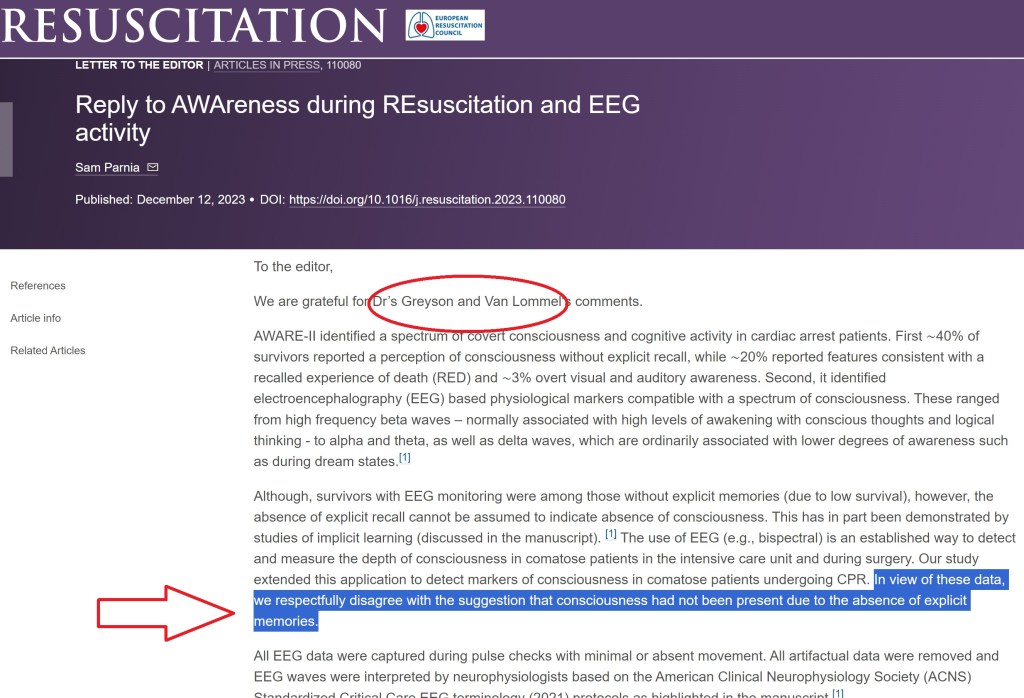
It is fine theorising that this may be what is going on, but the fact is some of his comments regarding the factuality of his hypothesis to the media (the Guardian and BBC in particular) seem to move beyond the word “may” to “is”. I have provided examples of this in previous posts, and it seems that two of the most respected researchers in this field have made some comments, to which Parnia has decided to reply in the journal (click on the pic for full article):

Now I can’t find the original comments, but it seems they stated that the subjects were not conscious. The fact is we do not know what was going on, so it is wrong to assert that there is or is not activity of any kind that is truly conscious. Since the vast majority of examples of EEG activity were in patients who sadly died, we do not know whether they had conscious experiences. Personally I believe the patients with EEG activity may have had some sort of CPRIC episode if anything, but I do not know that, no more than Parnia knows whether they had a disinhibition episode.

The fact is that only 2 of the 28 patients who were interviewed had interpretable EEG data. It is not mentioned whether there was activity or not, but either way these patients were not in the 11 who had recollections from their time during CA. If anything this would provide evidence against Parnia’s hypothesis.

I think that it is OK hypothesising as he does in the paper, but some of his recent media noise has gone beyond this, and I suspect that is why these two great men have given their esteemed colleague an academic poke. A part of me wonders if he is playing a much deeper game here, but I will keep my thoughts on that to myself.

Top Five NDEs

The most compelling veridical NDEs

In the absence of a scientifically verified OBE, I am going to update my book with the latest results from AWARE II and supplement it with the most compelling HCP (healthcare professional) verified OBEs. This is my starter list, please please add ones you think are more compelling or more recent in the comments then I will create a poll – remember they must be HCP verified:

Pam Reynolds

Dr Chris Yerrington’s case

Dr Rudy’s case

AWARE I NDE

Van Lommel study OBE

I want to include Maria and the Nike shoe (described by Kimberly Sharp in After the Light) but has this ever been verified in a documented manner by one of the attending HCPs? All the others have an MD or a senior nurse prepared to put their name to it.

Guardian Podcast with Parnia

Thanks Dylan for being first off the mark to notice this, much appreciated.

Click the pic to access the interview with Sam Parnia

I’ve now had a chance to listen this, and I would say it is possibly his best interview yet, so really recommend listening.

He clearly articulates his position on a number of different issues that we have discussed numerous times. He also asserts the fact we have been unable to understand consciousness from a scientific perspective, and that this entity is most likely separate and persists beyond death.

The skill with which he is able to articulate this in a manner that is digestible to the scientific community is outstanding. Despite the background “spook” Halloween music which could have undermined the credibility of what he was saying, he comes across as well balanced and engaged in genuine unbiased research to enhance our understanding of this topic. There are a couple of points that irk me, and one howler, but I’ve spent a lot of time already on them so won’t go there again for now.

The Guardian is a very skeptical newspaper so it is good for this to have appeared there.

Sam Parnia’s position in his own words:

Thank you Thomas for finding this. It is well worth a listen for all those who follow this blog and the AWARE studies. All the key positions are covered in the interview, and most importantly Parnia puts himself in the camp of scientists who believe that the brain hosts consciousness rather produces consciousness. Here is the link where you can find the 25 min audio clip:

https://www.rnz.co.nz/national/programmes/sunday/audio/2018908278/dr-sam-parnia-life-death-and-in-between

In general it was a really good interview. He comes across as extremely rational, thoughtful and balanced. I really liked his in depth explanation of the issues around medium term cellular viability, reperfusion injury and how the latter might be prevented. This is a big deal in the CPR world.

However, there are some positions he takes that I just cannot agree with, and that is not because I am experiencing cognitive dissonance (his explanation for people being unable to understand the idea of dualism when their minds are grounded in materialism). For me it is lack of evidence, or even evidence to the contrary that causes me to disagree with him on a few points, but also agree on others:

On prevalence of NDEs:

On remembering NDEs: he uses a “lunch” analogy and everyone remembers that they had lunch a week ago but don’t always remember what they had. Might be a useful analogy, but in his case not helpful to his position that most people have NDEs but can’t remember them. This analogy would suggest that if you had an NDE, you might not remember the details (although people tend to) but you would remember that you had an NDE. I use this in my book when discussing the issue of only 10% of elderly adults having recall.

On prevalence of lucid experiences:

He also says that he has evidence which suggests that many, if not all, are having lucid experiences during CPR. Unless he has something that he hasn’t presented, he does not have evidence to suggest this at all. He just has EEG signals not associated with anything other than performing CPR. Specifically he says:

“Conclusively, 40% of EEG changed to near normal up to 1 hour after”.

Firstly, 40% is not most people, but even the 40% is a bit of a stretch. This is taken directly from the AWARE II paper:

Importantly, near-normal/physiological EEG consistent with consciousness also emerged: delta, theta activity in 22% and 12% respectively (up to CPR 60 minutes), alpha 6% of data/images (up to CPR 35 minutes) and beta 1% (Fig. 2B).

https://doi.org/10.1016/j.resuscitation.2023.109903

If you add them all up they come to 40%, but delta and theta are associated with deep (dreamless) sleep or drowsiness, only alpha and beta are regarded as being associated with being awake or conscious, so at a push you might be able to say that only 7% had EEG that might be indicative of consciousness. (Mery, or Tim…pretty please…comment here). I am not an expert on EEG, but that is my understanding using this article as a source.

Link to an article on EEG and consciousness

I get why Sam is doing this, but I am not completely certain about it being 100% accurate. He is implying that nearly everyone has conscious activity during CPR. That is, putting it as politely as I can and given the data from his paper, not aligned with the facts.

RED vs NDE:

He says this distinction is important to differentiate experiences. Won’t go there, but I still prefer NDE.

On the process of dying

He describes it in terms of a process, a grey area, rather than binary dead vs alive. In physiological terms, I would agree…the grey area is between the definition of medical death (absence of vitals signs) and irreversible death (the legal definition and the source of a rather horrid falling out with Tim). Given the enduring viability of brain cells, the body is not permanently dead, but in terms of consciousness, it may be different, and that is where his hypothesis about disinhibition is interesting.

On his disinhibition discussions around 22:20

He says they have uncovered the mechanism that explains what may be going. Flatlining of the brain removes braking systems, people then get access to dormant parts of their brain and are able to access new dimensions of reality. This is a real experience that emerges with death.

If your brain has stopped working, how can you access dormant parts of it? Despite the wobbly rationale deployed, I like the disinhibition idea, and that the tethering normally holding the consciousness to the brain, is being released, but I think he needs to be lighter on the details as he has no real evidence for anything more than something may be going on. However, he has to build a bridge for materialists to walk over, and using the terms he does may achieve this.

Bad NDEs

He dismisses horrible NDEs as not being NDEs again, and attributes them to waking up in the ICU. This is contrary to the evidence provided in papers on negative NDEs. Been discussed before, so won’t go there again.

Overall a really good interview, that puts beyond any doubt his position on dualism, but I wish he would stick to what the evidence specifically allows for, rather than speculating way beyond those boundaries. That would be boring though and not be good entertainment, or newsworthy.

Brain Disinhibition Hypothesis

More from the Parnia lab. They have posted a graphic of their hypothesis on Instagram.

I like that they use the word “possible” in front of marker. I don’t like that they have 85 patients had EEG data with 20% of survivors having REDs right beneath it. For those who haven’t been following this or read the wording under fig 2 in the paper, the assumption will be that there is EEG data for this 20%. There is none.

Anyway, I have said enough about of what I think of this in previous posts, so won’t repeat that here. This is a very neutral hypothesis. It is an interesting idea. I do hope they are continuing with the study. The website implies they are.

A Cunning Plan?

I am not in anyway comparing Dr Parnia to Baldrick, but I do wonder if he has a cunning plan.

Ten days ago the media became aware that the AWARE II study had been published. I summarised some of the responses in this post:

https://awareofaware.co/2023/09/15/news-about-aware-ii-publication-and-a-comment-about-news/

The fact was that the AWARE II study was first published in July, and I covered the main details, including the EEG data, which was not associated with any recalled experiences, in this post:

https://awareofaware.co/2023/07/11/aware-ii-final-publication-speculation-does-not-imply-association/

It seemed that some interpreted the study in a way that suggested EEG data showed the brain was producing the NDEs, and this was in part due to the somewhat illusive way in which Sam Parnia discusses that data. In written publications his inference points towards these markers of consciousness being indicative of brain activity associated with NDEs. This lead some articles, such as the Scientific American piece, to suggest that the brain was producing the NDEs:

https://awareofaware.co/2023/09/19/i-avoid-swearing-on-this-blog-but-wtf/

You can’t blame them really as is it not very clear what Parnia is inferring. Then, a few days ago, the lab posted a reel on Instagram that made their position absolutely clear, and which I covered in this post:

https://awareofaware.co/2023/09/20/clarification-of-the-speculation/

In this reel (also available on their YouTube channel) he specifically states that they were able to show the mechanism by which disinhibition occurs:

https://www.instagram.com/reel/CxdjYcApTRB/?igshid=MzRlODBiNWFlZA==

The study was able to show for the first time electrical markers of these lucid hyper conscious real experiences. We were also able to show for the first time, the mechanism by which this experience occurs, which is that as the brain shuts down the normal braking systems that hold it down. This is known as disinhibition.

This, combined with the video describing this in more detail which specifically states that the consiousnesss is not anhilated at death, and the response to Thomas’ question, discussed in my previous post, causes us to conclude that the Parnia lab is claiming that their data shows that the EEG spikes are related to this event, and are markers of the consciousness accessing these states, and possibly leaving the body. The “packing its bags and leaving” hypothesis. This is despite the paper stating that there was no EEG data for patients who had REDs.

That is where we are, and I am wondering if it is all part of “a cunning plan”. Maybe the Parnia lab, realising the materialists would cite the EEG spikes as evidence of the brain causing NDEs, created their own theory as to why we see these spikes occur. Why not? If the materialists conflate data and get it published, why can’t we?

I have huge concerns about this. Dr Parnia says that he will create another video that goes into this mechanism in more detail. It is possible that he may relate it to some of the data obtained from research into psychedelics. Whether he does or not, he must have more evidence than he has currently published that specifically associates these EEG spikes with REDs or he is, in my opinion, and with all due respect, in danger of looking a teeny tiny bit like Baldrick.

I have been covering Dr Parnia’s work for over a decade now, and have enormous respect for him and his colleagues, but that would be severely undermined if he used EEG data from patients who never reported any recollections (most likely because they sadly died) as evidence that supports this mechanism. It is absolutely fine to suggest it as a hypothesis which must be proven in bigger studies, but to actually say that it “shows” something is going on is a step too far. It quite simply doesn’t unless he shows new data. I don’t want people to pile in here, as I said I like Dr Parnia a lot, but what he says must be consistent with the published or presented evidence or his work is no more credible than the various studies I have discussed here in which scientists state that a bit of EEG activity in rats or coma patients around the time of CA proves NDEs are the result of brain activity.

In summary, given the data we have been provided with it is impossible to draw any conclusions about the nature of what, if anything, is going on with the patients who had EEG spikes. End of.

Off the Fence? Maybe.

Thomas is smashing it this week. He sent a message via Instagram asking the Parnia lab at NYU about their position on the cause of NDEs after a new reel was posted.

NYU’s response to Thomas’s question

I won’t go into the whole issue of evidence on this for the moment, especially given Sam Parnia mentioned mechanistic evidence, I am just really glad that they made this clarification on their position. It is important to note they use the word “may”, and that is entirely the correct position to take given what we know about the study. I am very interested that they are going to explain their hypothesis soon.

Thanks Thomas and thanks Dr Parnia and the NYU lab for your continuing work in this field. Here is a link to the reel:

Parnia discussing their hypothesis

I will be creating a post over the weekend summarising what we have learned since the AWARE II study caught the attention of the media last week, what the absolute position is given the published evidence, my speculation on why things have been so “nuanced” (to put it politely) and thoughts about their approach to discussing this hypothesis.

Clarification of the speculation

Thanks Thomas for spotting this so quickly and it seems to be the basis of the Scientific American article as the wording is very similar.

We now have a very clear idea of their thinking. As Mery and Z pointed out, it is in line with what Parnia has said before – namely that the EEG activity they are seeing during CPR may be caused by the brain accessing memories and “different dimensions”, which is certainly thought provoking, but without any evidential basis (unless there is data they have not yet published).

The reason it is without basis, as I have repeatedly said, is because not one the NDE/REDs in the paper had EEG data, let alone EEG activity associated with them. They are speculating on data from the patients who were either not interviewed, or had no recollections. How can they say that the EEG data is associated with the brain accessing stored memories when there is no reported life review with associated EEG data (note, this may not be memories stored in the brain)?

Moreover, as Mery has said in the comments in my previous post, and we have discussed before, the nature of the EEG data does not really support the hypothesis that this activity during CPR could be indicative of consciousness level activity anyway. It is more likely similar to the noise the engine makes when you try to start a car on a cold morning but it doesn’t actually start. There is blood going to the brain, but not enough for it really fire up.

However, and much to my relief, at least the speculation by Parnia et al is still clearly along the lines of a dualist interpretation of what is going on, and that the consciousness persists after death of the physical body. This would contradict any speculation by the materialists that the EEG activity data is the brain causing the experience. Indeed that may be the purpose of all of this, and has been thrown out there by the Parnia lab to pre-empt the expected materialist response to their findings. Nonetheless, whether the speculation is dualist or materialist in nature, it is just speculation!

What on earth is going on?

‘He and his colleagues have developed a working hypothesis to explain their findings. Normally, the brain has “braking systems” in place that filter most elements of brain function out of our experience of consciousness. This enables people to efficiently operate in the world, because under regular circumstances, “you couldn’t function with access to your whole brain’s activity being in the realm of consciousness,” he says.

In the dying brain, however, the researchers hypothesize that the braking system is removed. Parts that are normally dormant become active, and the dying person gains access to their entire consciousness—“all your thoughts, all your memories, everything that’s been stored before,” Parnia says. “We don’t know the evolutionary benefit of this, but it seems to prepare people for their transition from life into death.”

https://www.scientificamerican.com/article/some-patients-who-died-but-survived-report-lucid-near-death-experiences-a-new-study-shows/

There is absolutely no scientific or other rationale that provides a basis for their speculation.

Let me repeat, in capitals: NOT ONE OF THE REDs REPORTED IN THE PAPER HAD ANY EEG DATA…LET ALONE EEG ACTIVITY. That is a fact.

On rereading the article, it is also clear that Scientific American are mixing their own interpretation with his musings on the cause of the EEG data.

Post Navigation