Given the title, I almost feel like I should wait till Halloween, however, it is ready and good to go and available in all Amazon markets as Kindle or paperback. It is not a horror story, although there may be some bits that are a bit scary! The genre is difficult to nail down – it is a spiritual sci-fi urban fantasy adventure! It is set in this world, in this time but incorporates the spiritual and also extra-terrestrial. It is not a full length novel, but a good sized half length (48k words). The second part, which will complete this novel, will be available some time next year. The more positive reviews I get and the more sales I make will determine the speed at which I write! I will be doing a Kindle countdown deal next weekend and heavily discounting the Kindle version to encourage purchases and reviews (not possible with the paperback), but if you like what I do here, and want to support me, then please buy it at full price. If you’re a bit skeptical about it, then wait till the weekend!
A former member of this blog, who shall not be named, wrote to me privately when I first mentioned this book, and was quite discouraging. Others were encouraging (thanks especially to Anna). Over 10,000 copies of the PDF of the first few chapters I put on here were downloaded and the poll was positive.
I actually wrote a version of this back in 1995, I then put it aside for many years focusing on work and other projects. While I would not say it is entirely original in that it ventures into NDE territory, I think that books are like pizza. Just because Pizza isn’t original, doesn’t mean that a new pizzeria can’t open up and sell pizza!
The blurb:
Mark Howland, a neurochemist specialising in psychedelic research, is desperate to overcome the grief that seared his soul when his wife died. He makes a drug that he believes will allow his consciousness to leave his body so he can see her again, but a catastrophe cuts his plans short.
Helen Richardson,former corporate spy, had a Near Death Experience that rocked the foundations of her worldview. She is determined to prove whether it was real, and Mark’s drug may be the path to achieving this, but first she must get her hands on it.
Her obsessive quest to learn the truth about what happens beyond the edge of life comes up against powerful forces, both seen and unseen. Her quest turns into a fight for survival and for humanity’s freedom.
If the above link doesn’t help, then click on the link below which should direct you to your local amazon market.
If you do read the book, and you enjoy it then please review or at the very least rate it (remember 4 stars is now average and 5 stars good. 3 stars or less is bad). If you really hate it, please consider carefully the impact a negative review will have. Each negative review is inversely proportional to 10 positive reviews. I have worked hard and already spent quite a bit of money to get to this point. At the end of the day if you really feel readers need to be warned off buying it, then place a negative review. Also, if you spot any typos or mistakes etc, please let me know in the comments or PM me. It has been copyedited professionally, and proof read by the missus and me, but there will still be mistakes!
The non-fiction book I have been working on will land in about 2 weeks time.
Sorry for the awful pun…couldn’t resist it though. I promise nothing so bad appears in either of my books (the novel is coming out tomorrow!)
This is really a footnote to the post I did on psychedelics and is the result of a conversation I had with an ER doctor. He is part of a group of intellectuals I recently started meeting with who discuss some of the deeper issues of life…much of it way too deep for me in fact, especially when it comes to theoretical physics etc. However, we got to discussing NDEs and OBEs and he told me that just a week before he had a phone call from a surgeon who had been performing an operation on his mother (the ER consultant’s mother). The mother had listed in her notes that she has a reaction to Ketamine, and yet the team had still used Ketamine as an anesthetic. Her reaction is that she experiences a full blown OBE. Having received the Ketamine, and had this reaction and still conscious, the surgeon had phoned this woman’s son to calm her down as she was freaking out. He was literally talking to her while she was on the operating table experiencing an OBE. Was it verified? No. Was it a true OBE, or some form of illusory autoscopy in which the brain tricks the person into believing they are seeing themselves? Impossible to know without doing an experiment designed to test this. I will mention it to the doctor next time I see him, but it is highly unlikely his elderly mother would willingly undergo the experience again as it terrified her.
So I did a bit of looking into this, and OBEs with Ketamine are a relatively common phenomenon. The mode of action of Ketamine is quite different from psychedelics and causes dissociative experiences. This paper written by a group from Ryerson in Canada describe the incidence of OBEs.
I contacted the author of the paper to ask if any further work had been done to try prove OBEs, and he said that there hadn’t been and that the phenomenen was almost certainly neurologically induced.
For me the key is complete lack of veridical OBEs for Ketamine induced OBE-like experiences. Given its widespread use in medicine, if the OBEs were true OBEs, then you would have hundreds if not thousands of veridical OBEs – as we do with NDEs.
In conclusion, I do not believe that Ketamine causes genuine OBEs.
“Charlotte Martial, a neuroscientist at the University of Liège in Belgium, who co-authored the study, is now trying to verify patients’ claims about their out-of-body experiences during NDEs. Around eight in ten people who’ve had an NDE report leaving their body, sometimes stating facts about their environment that they seemingly should not know. To test this, Dr Martial has decorated a resuscitation room at Liege University Hospital with unexpected objects and images, some of which are hidden in places that could be viewed only from the vantage point of someone near the ceiling – she is then asking patients who report NDEs if they’d noticed anything unexpected in the room.”
I mention this study in my soon to be published non-fiction book. Martial is not doing anything new here, and her study is much smaller in scope than Parnia’s, so it begs the question as to why she is doing it. I have my own theory on this and it is related to the fact that Martial is on the physicalist side of the debate. It is also related to the scientific method and the fact that for those who are into the semantics of this you can not prove a hypothesis to be true, you can only disprove it, or provide experimental evidence to support it. This is because there is always a potential unknown alternative explanation for a phenomenon. In reality we accept that hypotheses are proven true all the time, but for those who are pedantic about these things, it is is not technically correct.
Given what we know about the difficulty in validating OBEs – for instance Parnia reckons we would need tens of thousands of in hospital CAs to get one validated OBE – it is easy to devise an experiment that could disprove the hypothesis that “NDEs are a result of the consciousness leaving the body after death”. Here is how you would do it. you would start with a statement based on this hypothesis that says the following:
“If NDEs really are a result of the consciousness leaving the body, and 1 in 10 people who have CAs and survive have an NDE and 8 in 10 people who have NDEs report leaving their body (I will come back to that), then if 100 people die and are resuscitated, 8 of those people should leave their bodies and report observations from a room filled with secret images.”
So, you wait till you have 100 people survive CAs and no one has reported seeing an image, you can say you have disproven the hypothesis. That is almost inevitable because only 25% of NDEs have OBEs, and even then they may not remember seeing the image.
This, I believe is Martial’s game. It will take her a long time since if she is only using 1 ER suite then getting 100 survivors will take years, as we know. Also, there is an expression that you may have heard “the devil always overplays his hand”. I suspect she may end getting a “hit”, which will be galling for poor old Dr Parnia! I just hope she has the humility and scientific integrity to report it if she does. It would be so much more convincing coming from her than Parnia since she is a sceptic.
After months of promising, I am finally posting this article about Psychedelic’s and NDEs. The reason that I have been kicking it into the long grass is twofold. Firstly, I always have seen and still see, data from psychedelic trips as inconsequential in terms of challenging the validity of NDEs, as you will see, and secondly there is a lot of data to review, although I have decided to focus on one paper by Timmermann from 2018, and the 2022 Parnia consensus response, and some of his invective from his book Lucid Dying.
Interestingly I may have been in a position where I would not have been allowed to write about this. Last December I was in discussions around joining a company who were in the pre-launch phase for a psilocybin derivative for treating depression as their European medical scientific lead. I had reviewed the literature and was in two minds about the risk benefit ratio of the drug, and a little frustrated by the complete lack of reporting of “subjective” effects from the studies as I suspect the perceived nature of the subjective effects might actually have had an impact on outcomes such as suicidality. No matter, I didn’t get the position (good job as the recent FDA advisory committee came out against deploying psychedelics in healthcare at this stage).
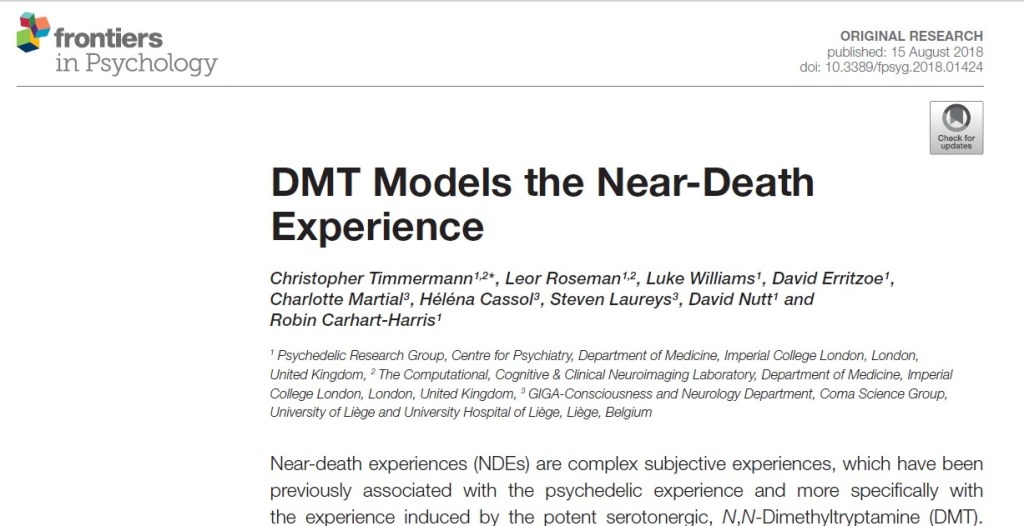
Now on to the subject. The paper that I focus on and is of most relevance is the one by Timmermann et al published in Frontiers in Psychology, not a premier academic journal. In this paper 13 patients took DMT and were given the standard NDE questionnaire afterwards. This was compared with a baseline questionnaire reflecting their non-“tripping” state, and with matched controls of people who had “authentic NDEs”.
One very important point to consider here is the fact that only 13 patients took part and they were selected through “word of mouth”. Ultimately, in my view, anyone volunteering through “word of mouth” recommendations to participate in a study taking DMT has a certain level of baseline “abnormality” that sets them apart from the normal population. Also using such a small number of patients makes it of low value in terms of the “meaningfulness” of any results. In truth, the study lacks any credibility at the outset because of these two points and would exclude it from a serious peer-reviewed journal due to this, but let’s car park that and consider what it says.
This is the key finding:
“All participants scored above the conventional cutoff (above or equal to 7) for a (DMT-induced) near-death (type) experience (Greyson, 1983). One of the 13 participants had a total score of 7 following placebo.”
The fact that one patient out of the thirteen reported an experience of greater than 7 on the NDE scale on placebo is very pertinent and speaks to the patient selection criteria…to be polite, they were probably not a representative selection of “normal” people.
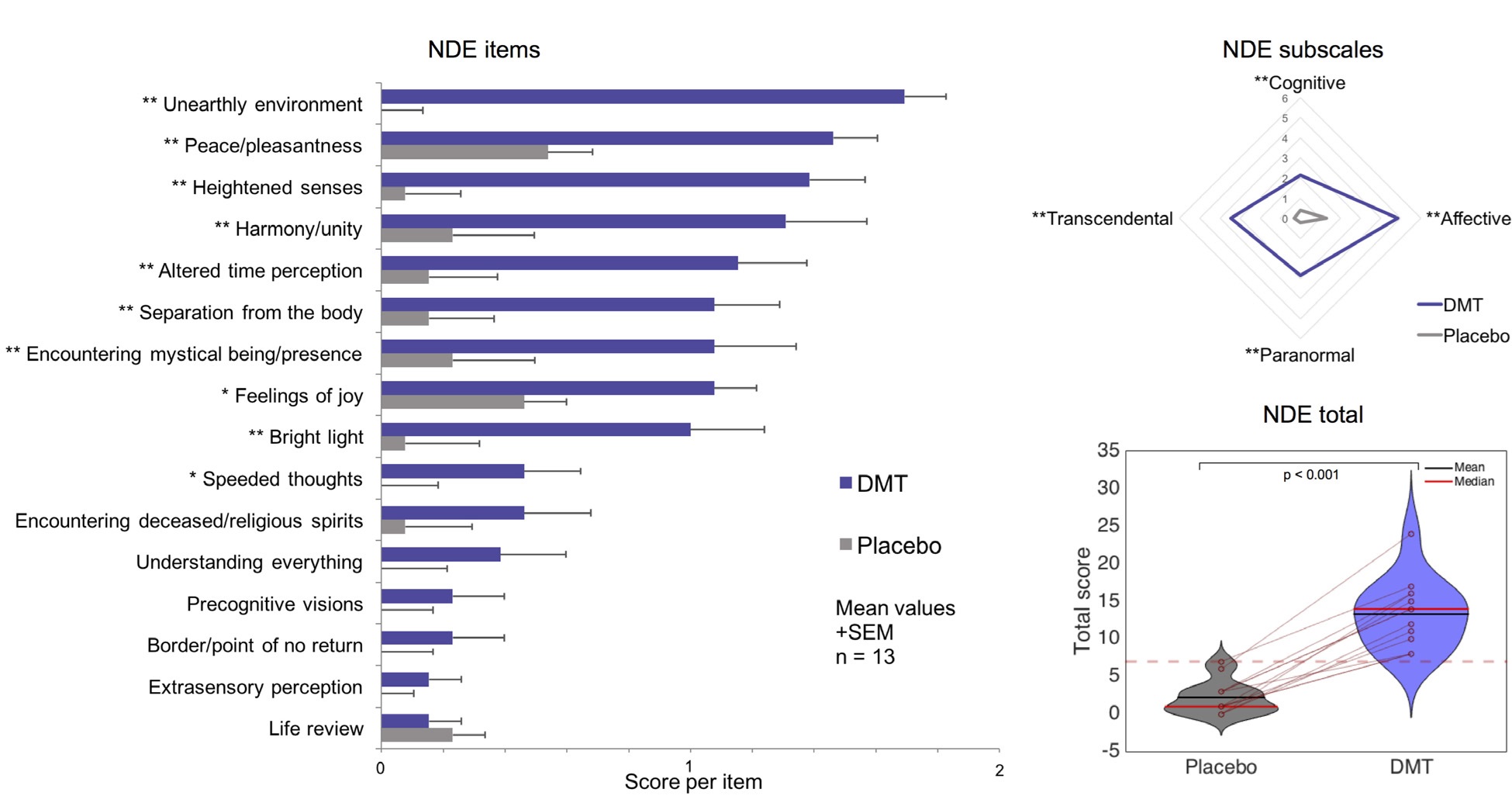
Below is a graphic of the breakdown of scores for the patients on placebo vs the same group of patients on DMT:
Now here I am going to depart to some anecdotal experience. I would never admit to taking illegal substances, but I may know someone extremely well…cough cough…who went through a period when they were at University a long while ago and spent about six months consuming a lot of weed. One particular batch of weed that this friend…cough cough…had must have been spiked as he went on a massive trip. In this trip he became a wolf in another world. He was still aware of the fact that he was lying on the floor of his bedsit in Southampton, but at the same time was having this “out of body” experience, with heightened senses – time seemed to slow right down – in another world (unearthly environment), and there was even some religious symbolism…probably a 7-10 on the NDE scale.
That is the point about the above graphic. This person…cough cough…knew this was not an NDE and yet would have scored over 7 on the NDE scale, and this person…cough cough…was not someone crazy enough to volunteer for a study in psychedelics, and as a matter of fact never bought weed from that supplier again.
In this study, which is probably the most relevant of its kind, they show that DMT creates an experience that scores the same on the NDE scale as authentic NDEs. However, as this person I knew very well has shown you can have an experience that is not an NDE but scores like one. This says more about the way that NDEs are scored than the value of any conclusions you can draw from this study with respect to psychedelics creating NDE-like experiences. To the author’s credit, this is somewhat recognized:
“It is important to acknowledge that the phenomenology of NDEs is still a matter of some investigation.”
This is why the 2022 consensus paper has some value as it seeks to more precisely define the different domains of experience. In that paper Parnia has the following to say in his section on psychedelics:
“Another major contributing factor that enables some to argue that drug-induced states are similar to so-called NDE involves the misuse of research scales that were developed for the specific study of so-called NDEs in non-context-specific circumstances, even though these are not designed for, nor are they sensitive or specific enough to distinguish a classical NDE from other experiences.”
In other words, the original Greyson scale was designed specifically for NDEs and not for other experiences so using this scale to look at DMT trips makes the findings less relevant.
Timmermann also cites a paper by another NDE investigator from the sceptic camp, Martial. He says that her work showed “that the temporal sequence of events unfolding during an NDE is highly variable between people and no prototypical sequence was identifiable.” This directly contradicts the narrative arc described in the consensus paper. However, on closer inspection of the Martial paper, while there is some heterogeneity in the order of some aspects of NDEs, the suggestion that there is no prototypical sequence is not an accurate conclusion to draw. I may review this paper at another time, but there are confounding factors in the paper to consider such as the fact that not everyone experiences all the elements (she does go a little way to addressing this by looking at reports which contained all of 4 specific common elements but the conclusions are the same for me). However, when you look at the highest percentage of experience reported at sequential timepoints T1-7, you get the following sequence:
T1-OBE>T2-feeling of peace>T3seeing a bright light>T4encountering people/spirits> (T5&6) coming to a border/boundary >returning to body.
This is very much in line with the narrative arc. You could argue that because they don’t all appear at the same time point there is heterogeneity, but in reality that heterogeneity lies in the fact that not everyone reports all the elements, and that some elements are not “time-critical” e.g. feeling of peace. Ones that are, such as OBE and return to the body, occur exactly where you would expect in the vast majority of those who report these elements. This points to Timmermann’s “confirmation bias”.
Parnia seems to have taken a leaf from my book when it comes to using pejorative terms when describing other people’s work. In Lucid Dying he says the following:
“Dr Timmerman’s claim was just another example of putting lipstick on a pig.”
Quite.
However, given that Parnia uses outrageous confirmation bias in the consensus paper regarding negative experiences, something I discuss in my soon to be published book in much greater detail, I will use my own cliché “pot calling the kettle black”.
All fun and games, and if Sam Parnia ever reads this blog, he will know that we all love him here and will hopefully take our criticism in a friendly way. What he does do an excellent job of in his 2022 paper is to go into a detailed analysis of the descriptions of psychedelic induced experiences vs NDEs and reveals how different they are in reality.
Ultimately though I regard all of this as a storm in teacup – the main reason why I have struggled to spend 3 hours on a day off prior to now to cover it.
This is because:
There is not a single veridical OBE validated by an accredited HCP who is prepared to go on the record from a psychedelic “NDE-like” experience. As we know from historical accounts, and the excellent work or Titus Rivas in The Self Does Not Die, there are hundreds if not thousands of these for authentic NDEs that defy natural explanation. In sum, these are incontrovertible proof of the validity of OBEs and NDEs.
If there were veridical OBEs in a DMT experience, so what? All this would prove is that psychedelic drugs can cause the consciousness to dissociate from the brain thereby proving that the consciousness is either independent of the brain, or that the brain is able to project a version of the consciousness beyond its physical confines and observe things that are naturally impossible to observe – mmm.
Now I know that the likes of Timmermann approach this from the other way round to the way I suggest that they do, namely that they try to infer that NDEs are just a physiological phenomenon induced by neurotransmitters like DMT trips, and not that DMT trips are like NDEs. This is the reductionist approach, but whichever way round you look at it, the similarities are superficial and do not stand up to scrutiny – the pig is most definitely wearing make-up.
Ultimately my highly speculative view of psychedelics, and while we are on this (and I may do separate posts on these at some point), other NDE-like experiences reported due to syncope or REM intrusions etc, is that they possibly disrupt the consciousness in a way that momentarily causes it to “wobble” within it’s physical confines. This speaks to Parnia’s disinhibition hypothesis (Eduardo – shush) and the idea that there is a physiological mechanism behind the consciousness “packing its bags and leaving” that may be facilitated by certain neurotransmitters. This is highly speculative, but maybe DMT, epileptic fits, syncope etc disrupt the tethers that normally keep the consciousness in place.
Hope you enjoyed. If you did please buy one of my books or buy me a coffee if you haven’t already,
I have given this five stars on Amazon as I know that anything less is regarded as average. Here, I would say 4.5/5. In summary an excellent detailed resource on NDEs from a rational scientific and philosophical perspective, but at times there is a bit too much detail for my liking, but I am still glad I bought it and would recommend to all who come here.
After an initial introduction he goes into a detailed overview of the pig brain studies, and other data that shows that the brain is viable for much longer than we think after death. If you are into science (as I am) and a story of how a great discovery was made, then worth sticking with it. There are some super interesting insights that you can glean from Parnia’s commentary of the whole Pig Brain episode, and how the full meaning of the results was deliberately conveyed in a confusing way. We on here however have understood the potential consequences – namely that a brain does not immediately die or decay within minutes or even hours, and if preserved in the correct manner that stopped any tissue degradation, and was reperfused in a way that avoided cellular damage due to reperfusion injury, could potentially be restored to full function, possibly many years later. This is all hypothetical as they haven’t yet presented data on allowing the pigs the possibility to function normally. This obviously has implications as to what happens to the consciousness in the intervening period.
He spends a lot of time discussing the terminology of death and how the use of the term “clinically dead” is unsatisfactory and meaningless but doesn’t really propose an alternative. I will stick with it for now!
Then he cites Bjorgin’s studies…oh dear. He has completely missed the fact that she claims the EEG signals happened during CA in the coma patients, but in fact happened before CA. It is somewhat concerning that he has fallen for it when others like Van Lommel have not. He does the same with Chawla’s data from 2009. My gut feeling is that her data feeds into his own personal pet theory of disinhibition as he goes on to weave the data of EEG signals around the time of death with AWARE II. If I am honest, much of it is a little misleading, and unless you are familiar with the studies he is talking about you will walk away with the conclusion that there is a lot of brain activity during early death and that it is definitely related to the experiences people report when they achieve ROSC and survive long enough to be interviewed. He thus overstates the importance of AWARE II. I’d probably do the same if I had spent years working on it!
On Page 74 of the Kindle version he alludes to the fact that the whole subject area is Taboo in science and medicine, and this may affect his approach and his desire to wed scientific observations with his personal dualistic understanding, but it doesn’t wash. As I have said so many times before, the observations of EEG activity before and up to 30 seconds post CA (in rats) without external assistance, or up to 60 minutes with CPR, have never been tied to actual conscious recollections, so all hypotheses proposed to explain this are purely speculative, and all evidence circumstantial.
He explains very well how the AWARE II study differentiated from other experiences such as psychedelic experiences (but only by including interviews from subjects who had reported NDEs outside of the study).
I must admit, since he hadn’t fully explained his theory of disinhibition before, I had made some assumptions about what he had previously said. He now focuses quite a lot on the disinhibition of natural processes that are normally inhibited (regulated) and mean we can cope with the vast amount of complex information in a sensible and coherent manner, and that when disinhibition occurs, the brain releases all kinds of hormones to kick the body back into life that would normally be inhibited. He also talks about accessing new dimensions of reality. However, he very much grounds this initial treatment of disinhibition into a physicalist explanation as “a unique state of hyperconsiousness”. Having done this he then moves into true NDE territory…the next phase of death…lucid death.
Page 104 (my Kindle version) is perhaps the most important quote regarding his absolute position on the subject:
“We agree that they experience a new dimension of reality in death. We also do not think the finding of brain electrical markers of hyperconsciousness means the brain is producing the experience. On the contrary, it means the mind and consciousness, tethered to the brain in death, are interacting with and modulating the brain. Of course, this discussion goes to the heart of the ancient mind-body problem, also referred to as “the problem of consciousness” by scientists and philosophers today.”
He is inferring this implies dualism. He may be right about dualism, and he may right about these neurological markers being that, but the EEG data itself is not direct evidence that supports that assertion…it merely allows speculation.
He then goes on to discuss NDEs of various people and the different aspects of them. He goes through each of the 50 different facets of the narrative arc he describes in the 2022 consensus statement. It is an expanded version of the original core elements and contains more detail and specifics. It is a particularly good reference and contains lots of excellent examples.
He then talks about the nature of consciousness, with a very detailed summary of the different theories of consciousness and how ultimately a brain-based understanding is not supported by the evidence. He cites Eccles and Hoffman a lot who have left behind physicalist or reductionist viewpoints.
He then looks at Olaf Blanke’s use of autoscopy to mischaracterise OBEs and says it is like putting lipstick on a pig. He is almost as outspoken about this and Timmerman’s work on psychedelics as I am about Borjigin’s claims. The gloves definitely come off!
Last section he goes into what it all means for us from a philosophical perspective. I agree with some of what he says, but disagree sharply on other stuff, but will leave that to the book that I am currently in the process of finishing and that will be available in the Fall. He talks about confirmation bias and cognitive dissonance…I recognise that I am possibly guilty of this at times but I think he has a blind spot towards his own failings in this area and regards himself as an impartial judge…but I will save that for my book.
One thing that comes out of the book is my sense that he has all but given up on a scientific verification of OBEs. I may be wrong, but he seems to have come a point where he regards the difficulties of gathering enough interviews of survivors as to be so overwhelming that he may have abandoned the effort of doing it. Hard to say. I hope not.
Anyway, I would recommend all NDE nerds buy the book. The first section is hardgoing, which his publishers should have helped him with, but it is worth sticking with it as you will really have a full and complete picture of the subject after finishing.
Firstly, I apologise (not for the first time!) about the long wait between posts. I have been working on my novel and a new non-fiction project. Both are now at copy-editing phase, so hopefully mid Fall will see me put them on Amazon.
Secondly, I apologise for not making this post about psychedelics. It is something that is coming, but requires reviewing a whole number of papers, and so is quite a bit of work. Probably be late August when I get round to it. But for now, this paper really piqued my interest.
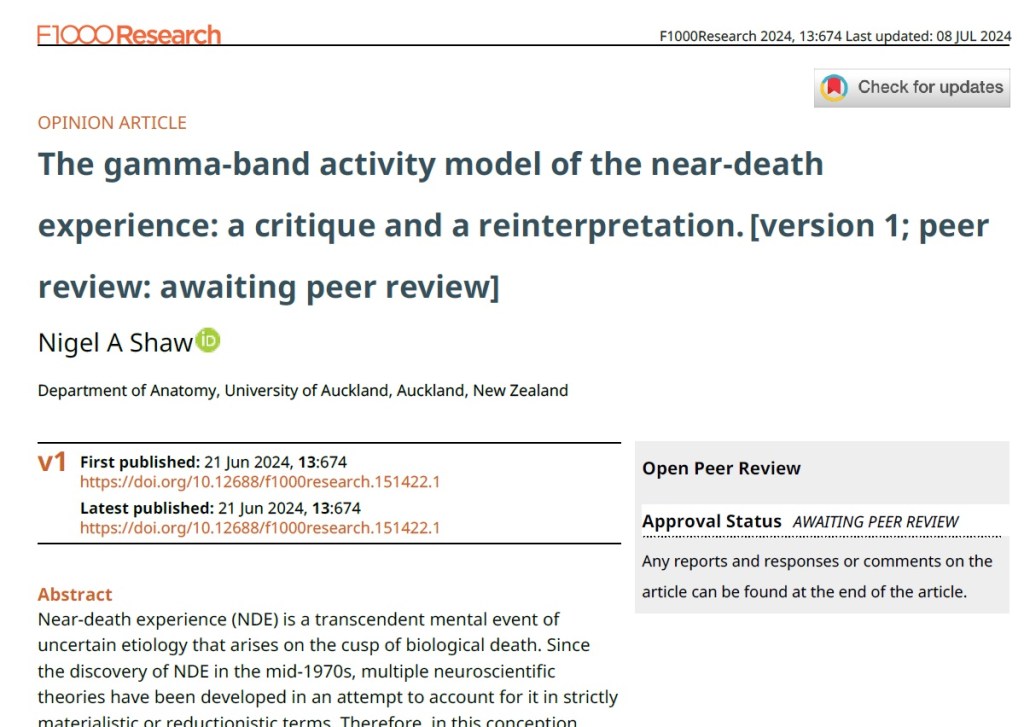
I was sent a link to it by Ian – thank you. It is a comprehensive and detailed review of the evidence relating to the proposition that gamma band activity (GBA) either before CA (peri-CA) in patients or animals in a coma, or up to 30 seconds post CA in rats, and up to an hour post CA in patients receiving CPR, could account for Near Death experiences.
This proposal, that GBA provides evidence that elements of the NDE are generated in the brain, have been most vocally promoted by Borjigin and other materialists. Parnia has repeatedly claimed that the GBA observed in patients undergoing CPR could be associated with an NDE (even if they haven’t been), but unlikely to be the cause. He suggests it is a sign of the consciousness accessing different dimensions. I have already produced countless words here explaining why neither of these claims is with serious foundation. Firstly, there were no reports of conscious recollection in any of the cases where GBA was observed, secondly, even if there were, association is not causation, but since we don’t even have association, the claims are just researchers trying to get attention…it’s what they do.
Anyway, that’s the back story. Something that has never been entirely clear to me in all of this is the “so what” of observing GBA. When you do a bit of research, it is clear that there is a consensus that Gamma activity on an EEG is associated with consciousness. Questions around strength of signal and precisely which wavelengths etc are most closely associated with conscious activity remain unanswered. This paper goes a long way towards answering some of these questions and discounting the idea that these transient episodes of GBA around the time of death could be evidence that the brain is producing the complex narratives that come out of NDEs.
It is a highly detailed paper, and not the easiest to read, however these are the key take-aways I got from it:
1. The link between gamma waves and consciousness, or states of awareness, has not been proven. It is strongly suspected to be the case, but due to the fact that gamma waves are somewhat ubiquitous, it cannot be stated with certainty that they are definitely linked, and less so in what way. For example:
The authors formally analyzed the absolute and relative power of GBA for both wakefulness and ketamine-xylazine anesthesia. For absolute power, little difference could be detected between the conscious and unconscious states for any of the four GBA subbands. Regarding relative power, there was a tendency for activity to increase during the waking period, but only in the medium and higher gamma bands. Such findings do not resolve the relationship between GBA and the level of arousal.
2. Not only has the link between gamma and conscious awareness not been proven, but there is evidence from research into psychedelics and “NDE-like” experiences, that gamma is less prominent:
What was discovered was the dominance of slow delta and theta oscillations was accompanied by a striking loss of spectral power in the faster rhythms. Such findings are, of course, quite contrary to the expectations of the GBA model. Assuming that the high-frequency burst of activity is actually associated with the induction of an NDE, it would be predicted that fast oscillations underlie the action of an agent such as DMT. This is strong implicit evidence that the surge in GBA at the moment of death is unlikely to be responsible for NDE.
3. The anatomical source of GBA around the time of death is not clear, especially post CA. For example, muscles produce gamma waves. Many of these studies claim to account for that, but there are inherent problems with capturing these signals, especially when using electrodes attached to the surface of the scalp. The GBA signals being picked up could be coming from almost anywhere, especially in the absence of other strong signals.
The more the GBA has been contaminated by artifacts, the less likely it is to fulfill its purported role as a kind of neural blueprint for NDE. It is a concern that those who propose a link between GBA and NDE choose to turn a proverbial blind eye to such a potential flaw or weakness in their argument.
This argument applies much less so in the coma patient’s peri-CA. In those patients (who are still alive incidentally – see my last post) the GBA is almost certainly from the brain, but exactly what it relates to is a subject of pure speculation. Moreover, while it is assumed that EEG activity is coming from the cortex, it is possible it is coming from the amygdala, as various experiments have previously shown.
These intermittent oscillatory emissions or signals arise in the basolateral amygdala (BLA) and consist of spindle-like bursts of high-frequency high-amplitude activity, typically lasting from seconds to minutes. They are endogenous but not strictly spontaneous because they can be evoked by a variety of stimuli. These included states of arousal, threat, learning, emotion, fear, stress, anticipation, pain, and noise. It might be predicted therefore, conditions such as hypoxia, ischemia, or cardiac arrest would provide an optimal milieu for the enhancement and/or appearance of the BLA rhythm. Nonetheless, it is in no way implied that these amygdaloid oscillations recorded from the cortex possess any mystical or psychedelic properties and, therefore, could be responsible for the NDE.
This very much echoes what I said in the video I made in the previous post, namely that instinctive and involuntary reactions to a state of hypoxia would probably cause parts of the brain responsible for fright and flight to light up and send signals out to get the body to move and start breathing again. This seems like the most likely explanation for any brain activity. It is desperately trying to resolve the threat. This is classic Ockham’s razor territory, something that the author states in his conclusions:
The present re-interpretation of the significance of the surges in GBA is obviously somewhat routine and quotidian, especially when compared with the more exotic, intriguing, and tantalizing alternative. It is unlikely to attract the same amount of attention from media. Nonetheless, it has the virtue of being parsimonious. As Ockham’s principle reminds us, simplicity is often a useful guide for scientific truth.
I also believe this is the most likely explanation of what we are seeing in Parnia’s CPR patients. Just enough blood is reaching the brain to cause primitive emergency responses to the state it is in.
In summary, the relationship between GBA and conscious awareness has not been fully established, and most definitely not characterised…in other words we cannot be certain that GBA and conscious awareness are linked, and even if we were, we don’t know how. Moreover, there is evidence from psychedelics that GBA is not associated with transcendental experiences with similar characteristics to NDEs. Finally, the anatomical source of the GBA in these studies may not be the cortex, but somewhere else, and more likely physiological in nature rather than of the kind of brain activity that would produce complex memories like NDEs.
So, whenever you hear about GBA being related to NDEs you will now know that the observation is meaningless regarding connection to or explanation of the phenomenon even if there was an associated NDE…which there never has been!
I said I wouldn’t do any more posts on the Borjigin group’s study, I haven’t. As requested by some followers, I’ve created a video explaining why the claims made by Borjigin don’t stack up.
In addition to an analysis of the study I have been able to get exclusive access to the first readout from the BEWARE study!
If you like the video please like and share. Also, I spent over ninety quid buying Pinnacle so I could edit the video, so please buy and review my book as well 🙂 ( or buy me a coffee)
Please let me know if you think this is over the top and in any way a personal attack on Borjigin. I will change it if people do think that and explain why. The attack I make is on her conclusion, which I demonstrate to be false. (One regular has mentioned that this video feels a bit like an ad hominem attack on Borjigin’s beliefs – I have tried hard to avoid doing precisely that, although it was very tempting given the way she referred to Van Lommel’s work…something not shown in my video, but in her lecture, when she subtly implied that he made up the reports of a flatline EEG in the Pam Reynold’s case. My references to atheist research, and being wary about research that supports their position, were meant in general and not specific to her. I have many years experience in this field and in the origin of life research of atheists (and theists) who allow their bias to corrupt their interpretation and representation of facts. The truth is I cannot tell whether Borjigin deliberately or carelessly misrepresented the data from the coma patient study. Neither is good though.)
I don’t want to spend too long on this as I have already made the key points in the previous post, but I do want to highlight how utterly fallacious Borjigin’s assertions about NDEs are . This link to a video of her reviewing her work was provided by Dave:
The link was accompanied by a question from Dave, which I am sure many lay people would ask after watching this video:
“Borjigin seems to present data that shows the brain activity still continues for minutes after cardiac arrest, not just 30 seconds…. doesn’t her evidence in this talk show that the brain can continue receiving electrical signals for long periods [after CA]?”
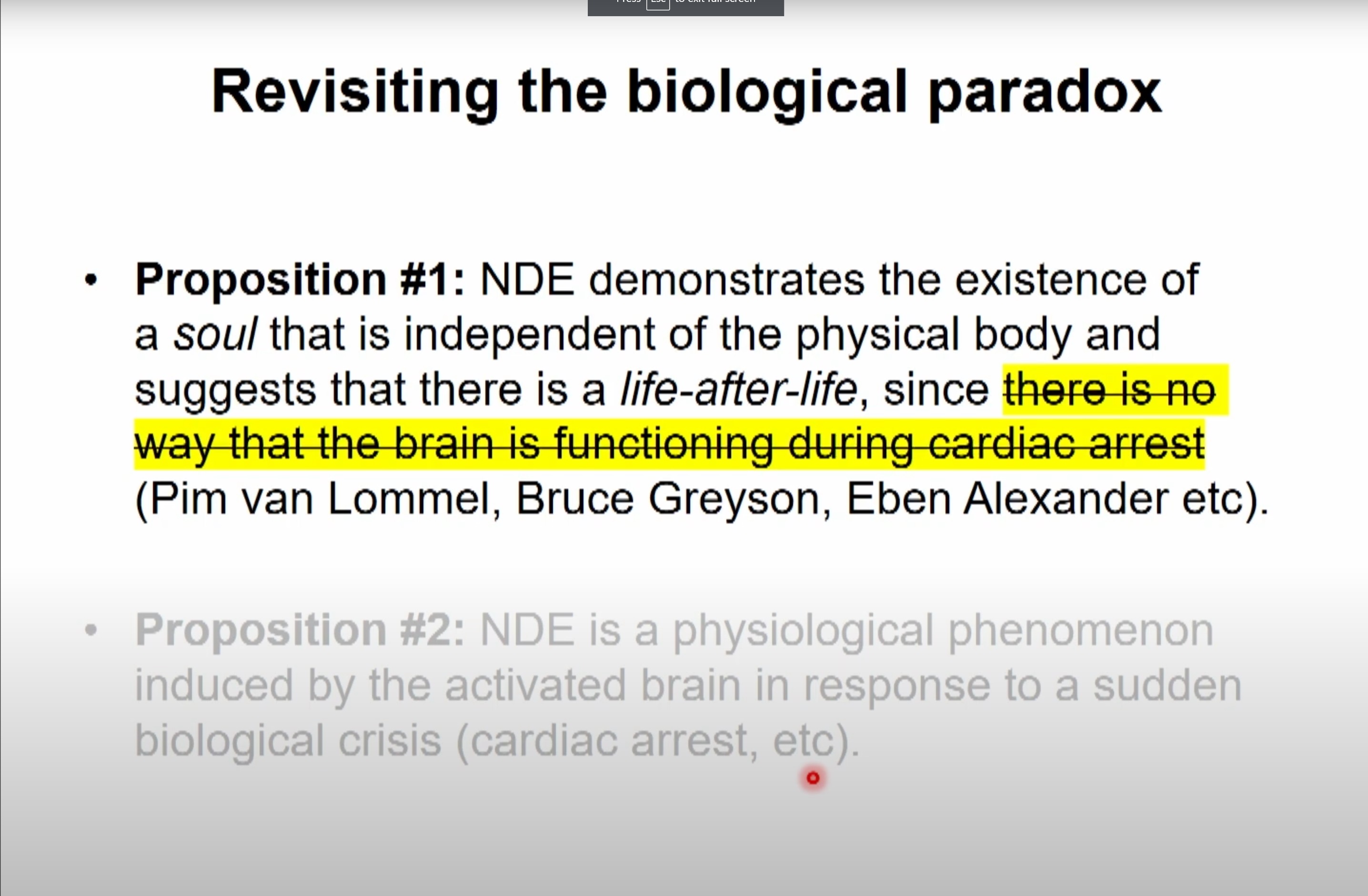
Firstly, I do not want to launch an ad hominin attack on Borjigin (I have had to temper some of my language on second edit), but having watched this video there are only two possible conclusions that you can draw about her as a scientist when she presents a slide like the one below.
She claims that she has disproved the key assumption that Pim Van Lommel and other proponents of NDEs make, namely that the brain stops being active at the point of or very soon after Cardiac arrest [begins] (10-20 seconds maximum) and that therefore consciousness is not possible and so NDEs are evidence that the consciousness, or soul, persists beyond death.
Borjigin claims that her data shows that in both animals and humans that the brain is showing signs of consciousness for long periods during cardiac arrest. She says “We win!”.
Her claim is demonstrably false and they haven’t “won”.
This is what Borjigin has shown:
When cardiac arrest is induced in rats, there is brain activity for up to 20 seconds afterwards.
When rats are killed slowly by denying them oxygen (asphyxia) their brains show increased activity for a period after asphyxia, but it stops before cardiac arrest.
In 2 human coma patients she shows a similar result in that when oxygen is withdrawn, there is an increase in EEG activity (and the heart rate goes up). All EEG and ECG activity stop simultaneously after about 5 minutes i.e. brain activity ceases at the point of cardiac arrest…which is the common observation of most ER doctors, and actually proves what Van Lommel says i.e. the brain ceases activity at or very soon after CA.
Clearly something is not adding up with what she is saying. It is either a deliberate attempt to deceive or a gross misunderstanding of the key term under consideration in this paper and Van Lommel’s assertion. It is quite embarrassing for Borjigin, but I am starting to wonder if it is the latter, although still entertaining the former.
Borjigin is equating the onset of asphyxia with the beginning of Cardiac Arrest. Let’s just once again look at the definition of cardiac arrest, the definition used by physicians, cardiologists etc and most certainly Van Lommel, Greyson, Parnia et al:
“Cardiac arrest occurs when the heart suddenly and unexpectedly stops pumping. If this happens, blood stops flowing to the brain and other vital organs.” NIH defintion
Cardiac arrest is when the heart has stopped beating. CARDIAC ARREST IS NOT THE PERIOD OF CARDIAC ACTIVITY PRIOR TO THE HEART STOPPING, THE PERIOD THAT BORJIGIN IS DISCUSSING.
By using the point at which oxygen is withdrawn to define the beginning of cardiac arrest is either extremely mendacious or extremely ignorant, and in doing so Borjigin manufactures her widely reported and, at least by the complicit materialist types, accepted fallacy that brain activity continues for long periods during Cardiac Arrest.
I am now going to do my own analogous experiment. Hold on…
….OK, I’m back. I breathed normally, then, without taking a deep breath, halfway through exhaling, I grabbed my nose, and sealed my lips. After 45 seconds in a “Borjigin defined Cardiac Arrest”, I started to get quite anxious. My brain was running hot (or to quote Borjigin “literally brain on fire.”), so I took a breath. That is the EEG activity she is describing (albeit in comatose patients without oxygen or rats breathing in CO2). I kid you not.
I think the BEARS idea makes obvious sense (the brain goes into meltdown when the blood it is receiving contains less oxygen than needed), but only while the heart is beating and as for the brain stopping the heart to preserve brain function…let’s just say that towards the end of the video some of her arguments descend into farce, replete with glaring contradictions. As a scientist myself, my cringeometer was off the chart. I had to stop, it was excruciating, I would have thrown something at my expensive new Samsung TV.
I am happy to answer any questions you have about this video and Borjigin’s work in this post, but I will not waste another full post on her nonsense.
This is a quick follow up to my post on the Guardian article yesterday in which various claims about activity of the brain after cardiac arrest were made by the journalist, probably based on what was said by the researcher, Jimo Borjigin.
Reminder of the egregious line in the Guardian, which is fundamental to understanding whether or not NDEs could be a result of brain activity or not:
After cardiac arrest, blood and oxygen stop circulating through the body, cells begin to break down, and normal electrical activity in the brain gets disrupted. But the organs don’t fail irreversibly right away, and the brain doesn’t necessarily cease functioning altogether.
I stated in my post that that it does cease functioning in the coma patients (in rats it goes on for about 30 seconds). This was from my memory of the original paper, which I have been reading again this morning. In this paper Borjigin says this in the conclusion:
These data demonstrate that the human brain can be active during cardiac arrest.
Although this is subtly different from what the journalist says, who states activity is after, it is in itself still misleading, and where I start to wonder if another word associated with mendaciousness would be more appropriate. First the Johns Hopkins definition of Cardiac arrest:
Cardiac arrest, also known as sudden cardiac arrest, is when the heart stops beating suddenly. The lack of blood flow to the brain and other organs can cause a person to lose consciousness, become disabled or die if not treated immediately.
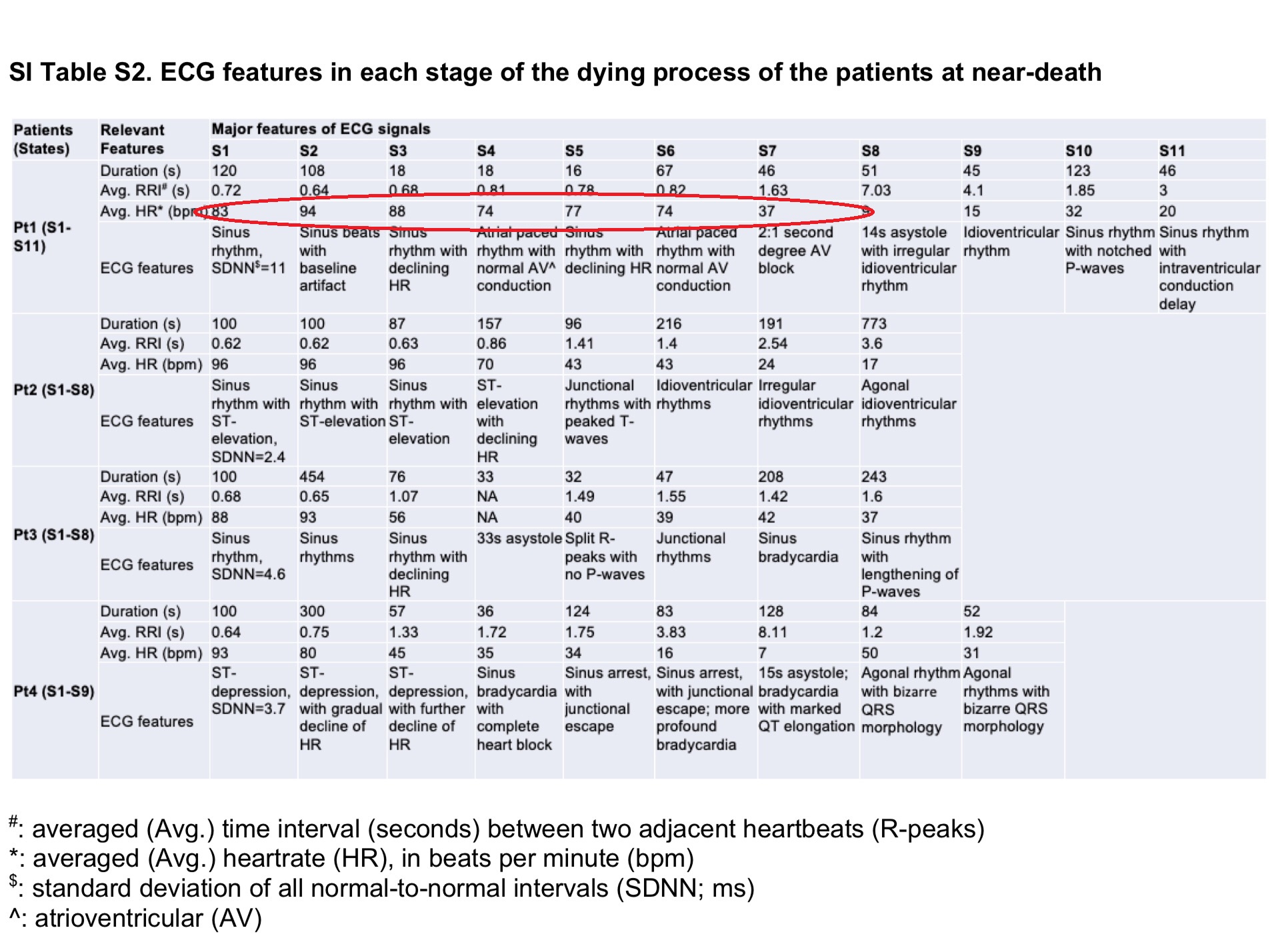
Cardiac arrest is when the heart has stopped beating. Here is the ECG data from the Borjigin study:
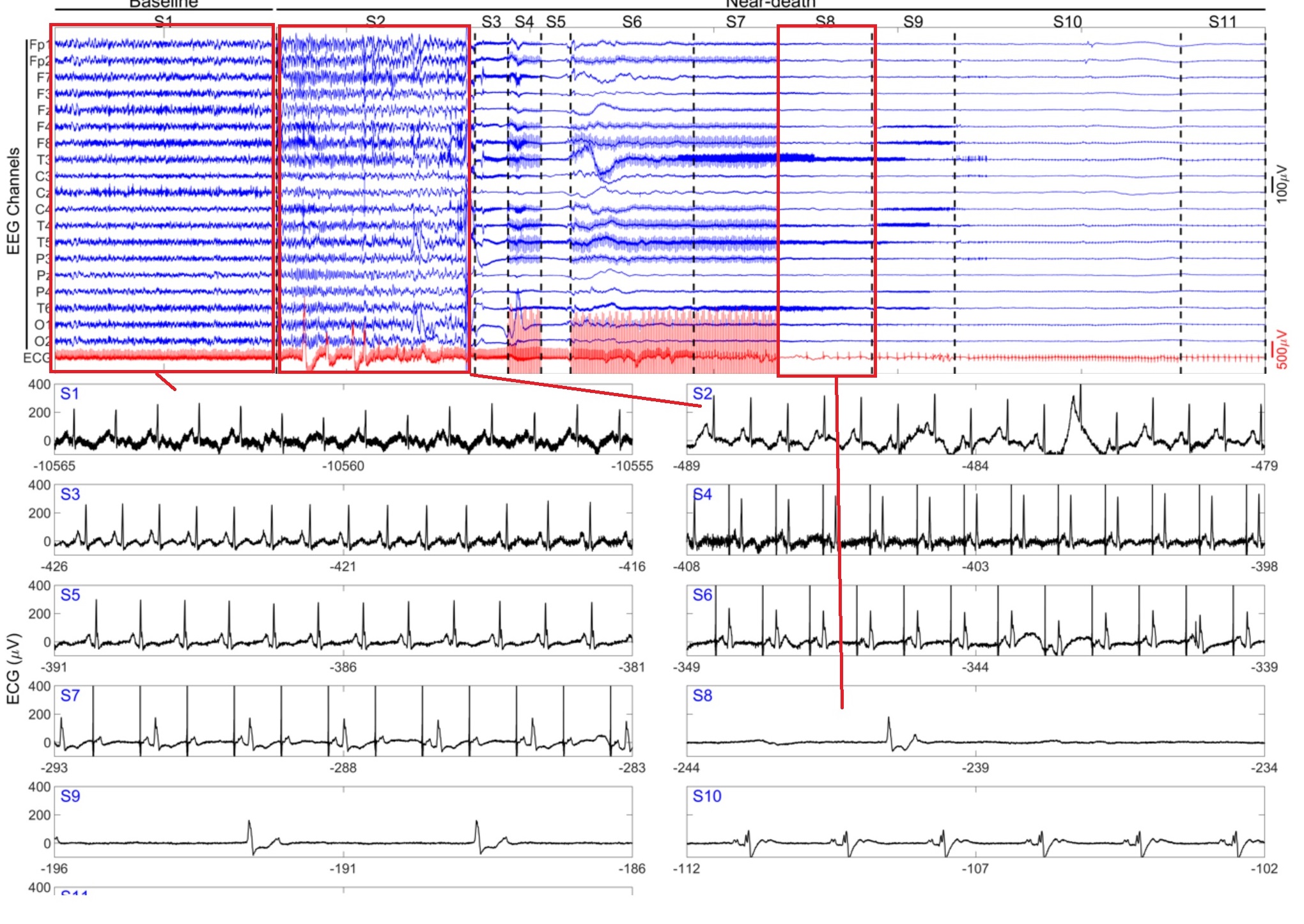
Patient 1 is the subject from whom they have most of the data and indeed draw many of the conclusions they make from. Patient 1 had a longer period of EEG activity. Note the Average HR in each time period (S1-11) never drops to zero, although during 8-9 the HR falls to below levels that would sustain consciousness, and arguably is in Cardiac arrest, up to S7 the HR is normal, then in S7 it starts dropping as the lack of oxygen and life support causes the beginning of CA. Now look at the EEG vs ECG data for patient 1:
In the paper Borjigin makes much of the coupling of gamma waves across different frequencies. If I’m honest I don’t have the expertise to understand exactly what she is saying, but to the untrained eye, most of the relevant activity seems to stop after S2 when the heart is still beating fairly normally. However, at the beginning of S2 there is a huge change in the conditions the body is experiencing – life support in the form of oxygen has been withdrawn. Is this uptick in EEG activity just the brain trying to induce consciousness so that the consciousness can react to whatever is causing the catastrophic change? Why make the assumption that this is what is causing NDEs when there could multiple explanations.
I have a little analogy here, and I don’t know how relevant it is. Some nights I have sleep apnea later in the night and I have noticed something about my dreams just before I wake up…they suddenly turn into nightmares. This morning I had just such an episode. The dream was going all very well, then suddenly I was about to go over a cliff. I awoke and realised that I was gulping air and so had an episode of sleep apnea. My dreaming conscious state basically gave my brain a kick up the backside due to lack of oxygen. Is that is what is happening with these patients (well patient 1 and 3 who show this)? The lack of oxygen is causing the brain to induce a conscious state of alertness, only with these patients, for whatever underlying pathological reason, the ability to physically wake up is impossible.
So, during S2 it is entirely plausible that the person is experiencing conscious activity. It is not unreasonable to speculate that this could be an experience like an NDE, but given that neither rats or comatose humans have any reports of NDEs we will not know. Given my experience, these nightmares are all random in nature…definitely no peace! Patients with sleep apnea have been studied widely, and I am sure there are plenty with EEG data (in fact I know there are as I once worked in sleep medicine), it would be interesting to know what happened to their EEG when there was an apnea as it is a good analogue of what might be happening here.
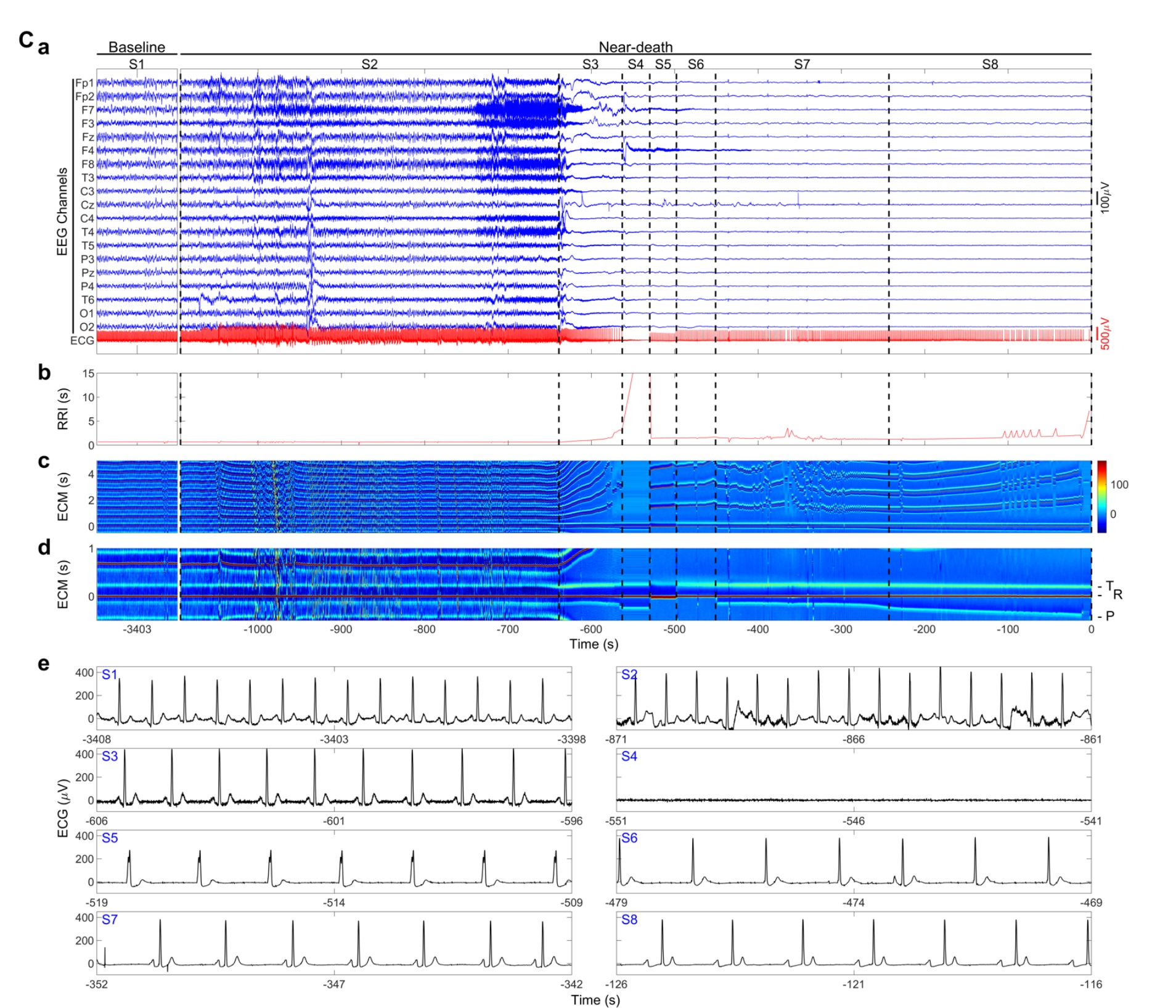
Here is patient 3:
In this instance the author does not claim there is much gamma coupling outside of phase 2.
All this is interesting, and thought provoking, and points to the potential of conscious activity immediately prior to death in coma patients, but absolutely does not support the sentence used in the Guardian and let’s just lay the facts out that we have from all research on this subject:
EEG associated with conscious activity has been reported just prior to CA and death in coma patients
EEG activity that could be associated with conscious activity has been reported up to 30 seconds after death in rats
EEG activity that could be associated with conscious activity has been reported in patients receiving CPR (and therefore a supply of oxygenated blood to the brain) up to 60 minutes after CA
In none of these instances has there been any reports of actual conscious activity by humans (or rats), let alone an NDE
Researchers and journalists that try to use this data to suggest that conscious activity extends into post CA for more than 20-30 seconds without artificial assistance are misleading at best. It is shameful when this is such an important subject.
I am in the process of writing my piece on Psychedelics, but today the Guardian followed up its recent interview with Sam Parnia, with this, and I decided it was worth addressing since your friends and family may bring it up (my mother has already!). The Psychedelics article is coming…promise!
This article starts out with a fairly balanced account of how the field of NDE research evolved. It lulls you into a false sense of security that the balance will continue, but whenever you read the name Borjigin referred to in terms of progress in understanding, then you know that balance is likely to evaporate very quickly.
My previous post relates to the kind of work that Borjigin does, and the data that she has produced. In summary, and for the umpteenth time, Borjigin and others have shown that in rats brains activity can persist for maybe up to a minute after death without CPR. The studies in human coma patients have shown that immediately prior to death, and immediately after life support is withdrawn, coma patients have a number of minutes in which the brain produces EEG data that might be associated with consciousness. Moreover, Parnia’s own data has shown that the brain is capable of producing activity that might be associated with consciousness up to an hour after CA but while CPR is being administered and therefore while there is still oxygenated blood flow to the brain. I have explained ad nauseum here why this data, while interesting, says absolutely nothing at all about NDEs since no NDE has to date been reported that could even be associated with, let alone correlated with EEG activity. Nothing. Using the coma patients is particularly egregious since the patients had no reported EEG activity after death.
However, because of the profile of the Guardian, and the bias that emerges towards the end of this article, it is my duty to provide a reminder to people on here that to draw the conclusion that this EEG activity is the cause of NDEs is a gross conflation. The author also makes false assumptions:
As more and more people were resuscitated, scientists learned that, even in its acute final stages, death is not a point, but a process. After cardiac arrest, blood and oxygen stop circulating through the body, cells begin to break down, and normal electrical activity in the brain gets disrupted. But the organs don’t fail irreversibly right away, and the brain doesn’t necessarily cease functioning altogether.
Yes it does. Without the flow of oxygenated blood, the brain stops functioning after about 30 seconds. The journalist has misunderstood the findings of the studies, or is deliberately misrepresenting the findings of the studies. This is the kind of understanding that is picked up by the reader who goes on to parrot or paraphrase that “the brain can work for hours after death”. As we on here know, it is capable of working hours after death provided that cellular death has not occurred on too large a scale, but without the flow of oxygenated blood, it does not work. Just like a computer without power. I suspect that this misunderstanding was helped by Borjigin who we well know can be misleading in the use of language:
At the very least, Patient One’s brain activity – and the activity in the dying brain of another patient Borjigin studied, a 77-year-old woman known as Patient Three – seems to close the door on the argument that the brain always and nearly immediately ceases to function in a coherent manner in the moments after clinical death. “The brain, contrary to everybody’s belief, is actually super active during cardiac arrest,” Borjigin said. Death may be far more alive than we ever thought possible.
The implication is that the brain is active in CA for long periods without CPR. There is zero evidence to support this and decades of data to contradict it. WITHOUT THE SUPPLY OF OXYGENATED BLOOD THE BRAIN BECOMES COMPLETELY INACTIVE WITHIN A MINUTE OF DEATH AT MOST (and usually within 20-30 seconds).
Unfortunately once such a fundamental false understanding is assumed to be fact, then you know that the article can only go one way…and it does.
“So far, there is no sufficiently rigorous, convincing empirical evidence that people can observe their surroundings during a near-death experience,” Charlotte Martial, the University of Liège neuroscientist, told me. The parapsychologists tend to push back by arguing that even if each of the cases of veridical near-death experiences leaves room for scientific doubt, surely the accumulation of dozens of these reports must count for something. But that argument can be turned on its head: if there are so many genuine instances of consciousness surviving death, then why should it have so far proven impossible to catch one empirically?
Definition of empirical: based on, concerned with, or verifiable by observation or experience rather than theory or pure logic.
Using this definition then the 130 odd cases in the The Self Does Not Die is empirical evidence. What he really means is scientifically verified cases, i.e. cases that have been proven using the scientific method. Create hypothesis to explain a phenomenon – devise experiment to test hypothesis – results from experiment verify or falsify hypothesis. The ‘journalist’ does not explore the possible reasons why there have to date been no scientifically verified OBEs, but I have explained many times on here why the AWARE studies have not provided a scientifically validated OBE. This shows his bias, in that he will only come up with materialist objections.
This is super interesting though:
Borjigin hopes that understanding the neurophysiology of death can help us to reverse it. She already has brain activity data from dozens of deceased patients that she is waiting to analyse. But because of the paranormal stigma associated with near-death studies, she says, few research agencies want to grant her funding. “Consciousness is almost a dirty word amongst funders,” she added. “Hardcore scientists think research into it should belong to maybe theology, philosophy, but not in hardcore science. Other people ask, ‘What’s the use? The patients are gonna die anyway, so why study that process? There’s nothing you can do about it.’”
This is proof, as if we needed it, that the scientific community, or the funding establishment, is overtly suppressing research into this most important of fields – even when the research might support a materialistic finding! Parnia has alluded to this before. It stinks, but there is nothing we can do about it.
Towards the end we see the author’s bias against anyone who entertains belief in the possibility that these experiences might be real and evidence of the understanding that the consciousness persists after physical death. This is overt gaslighting of anyone who might be “NDE curious”:
Meanwhile, in parts of the culture where enthusiasm is reserved not for scientific discovery in this world, but for absolution or benediction in the next, the spiritualists, along with sundry other kooks and grifters, are busily peddling their tales of the afterlife. Forget the proverbial tunnel of light: in America in particular, a pipeline of money has been discovered from death’s door, through Christian media, to the New York Times bestseller list and thence to the fawning, gullible armchairs of the nation’s daytime talk shows. First stop, paradise; next stop, Dr Oz.
Now, while I say it is gaslighting, I have a little sympathy for this position. Having spent a number of months going through YouTube NDE accounts, and reviewing the literature of “post tunnel events”, my position on NDEs has subtly changed. OBEs are objective, but what happens once people venture beyond the observations they make of this world, while having some common core themes, are so utterly different and unique, that I am coming to some conclusions about them that differ from the mainstream NDE community position. This will be presented in my next non-fiction book which I will publish later this year (after Part 1 of my fiction book is complete). However, this section of the article is 100% gaslighting and is deliberately attempting to manipulate those who may be “NDE-curious” into scuttling back into their materialist pens lest they be regarded as kooks or gullible. Nasty.
So if someone brings this article up and says “I read an article that says there is proof the brain is active for long times after CA and that is causing NDEs” hopefully you will now be suitably equipped to put them straight. If not then review the countless posts I have created responding to these claims before.

 AwareofAware