Lipstick on a tripping pig
After months of promising, I am finally posting this article about Psychedelic’s and NDEs. The reason that I have been kicking it into the long grass is twofold. Firstly, I always have seen and still see, data from psychedelic trips as inconsequential in terms of challenging the validity of NDEs, as you will see, and secondly there is a lot of data to review, although I have decided to focus on one paper by Timmermann from 2018, and the 2022 Parnia consensus response, and some of his invective from his book Lucid Dying.
Interestingly I may have been in a position where I would not have been allowed to write about this. Last December I was in discussions around joining a company who were in the pre-launch phase for a psilocybin derivative for treating depression as their European medical scientific lead. I had reviewed the literature and was in two minds about the risk benefit ratio of the drug, and a little frustrated by the complete lack of reporting of “subjective” effects from the studies as I suspect the perceived nature of the subjective effects might actually have had an impact on outcomes such as suicidality. No matter, I didn’t get the position (good job as the recent FDA advisory committee came out against deploying psychedelics in healthcare at this stage).
Now on to the subject. The paper that I focus on and is of most relevance is the one by Timmermann et al published in Frontiers in Psychology, not a premier academic journal. In this paper 13 patients took DMT and were given the standard NDE questionnaire afterwards. This was compared with a baseline questionnaire reflecting their non-“tripping” state, and with matched controls of people who had “authentic NDEs”.
One very important point to consider here is the fact that only 13 patients took part and they were selected through “word of mouth”. Ultimately, in my view, anyone volunteering through “word of mouth” recommendations to participate in a study taking DMT has a certain level of baseline “abnormality” that sets them apart from the normal population. Also using such a small number of patients makes it of low value in terms of the “meaningfulness” of any results. In truth, the study lacks any credibility at the outset because of these two points and would exclude it from a serious peer-reviewed journal due to this, but let’s car park that and consider what it says.
This is the key finding:
“All participants scored above the conventional cutoff (above or equal to 7) for a (DMT-induced) near-death (type) experience (Greyson, 1983). One of the 13 participants had a total score of 7 following placebo.”
The fact that one patient out of the thirteen reported an experience of greater than 7 on the NDE scale on placebo is very pertinent and speaks to the patient selection criteria…to be polite, they were probably not a representative selection of “normal” people.
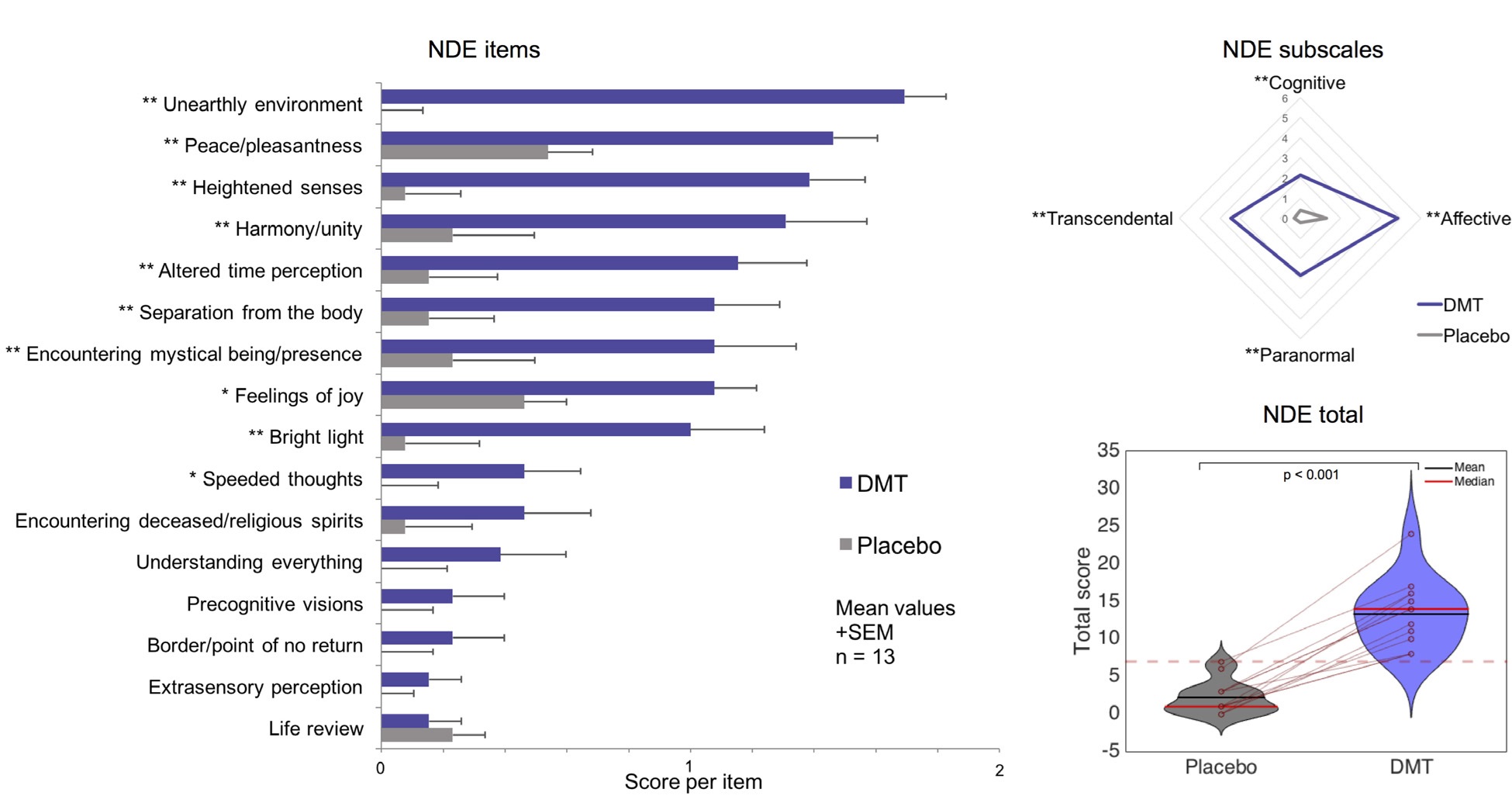
Below is a graphic of the breakdown of scores for the patients on placebo vs the same group of patients on DMT:
Now here I am going to depart to some anecdotal experience. I would never admit to taking illegal substances, but I may know someone extremely well…cough cough…who went through a period when they were at University a long while ago and spent about six months consuming a lot of weed. One particular batch of weed that this friend…cough cough…had must have been spiked as he went on a massive trip. In this trip he became a wolf in another world. He was still aware of the fact that he was lying on the floor of his bedsit in Southampton, but at the same time was having this “out of body” experience, with heightened senses – time seemed to slow right down – in another world (unearthly environment), and there was even some religious symbolism…probably a 7-10 on the NDE scale.
That is the point about the above graphic. This person…cough cough…knew this was not an NDE and yet would have scored over 7 on the NDE scale, and this person…cough cough…was not someone crazy enough to volunteer for a study in psychedelics, and as a matter of fact never bought weed from that supplier again.
In this study, which is probably the most relevant of its kind, they show that DMT creates an experience that scores the same on the NDE scale as authentic NDEs. However, as this person I knew very well has shown you can have an experience that is not an NDE but scores like one. This says more about the way that NDEs are scored than the value of any conclusions you can draw from this study with respect to psychedelics creating NDE-like experiences. To the author’s credit, this is somewhat recognized:
“It is important to acknowledge that the phenomenology of NDEs is still a matter of some investigation.”
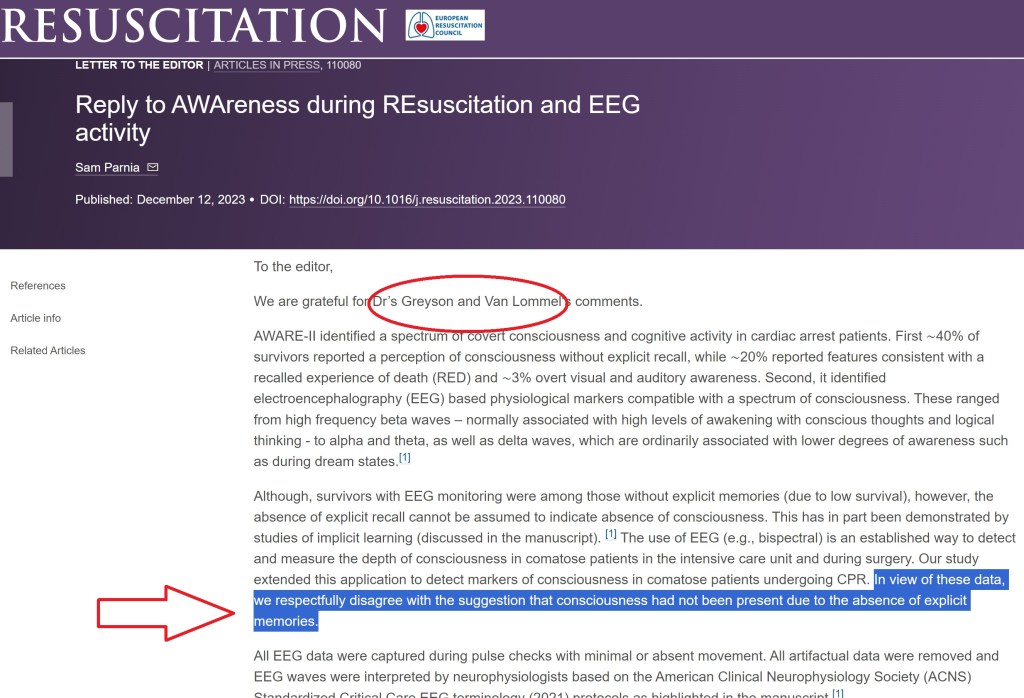
This is why the 2022 consensus paper has some value as it seeks to more precisely define the different domains of experience. In that paper Parnia has the following to say in his section on psychedelics:
“Another major contributing factor that enables some to argue that drug-induced states are similar to so-called NDE involves the misuse of research scales that were developed for the specific study of so-called NDEs in non-context-specific circumstances, even though these are not designed for, nor are they sensitive or specific enough to distinguish a classical NDE from other experiences.”
In other words, the original Greyson scale was designed specifically for NDEs and not for other experiences so using this scale to look at DMT trips makes the findings less relevant.
Timmermann also cites a paper by another NDE investigator from the sceptic camp, Martial. He says that her work showed “that the temporal sequence of events unfolding during an NDE is highly variable between people and no prototypical sequence was identifiable.” This directly contradicts the narrative arc described in the consensus paper. However, on closer inspection of the Martial paper, while there is some heterogeneity in the order of some aspects of NDEs, the suggestion that there is no prototypical sequence is not an accurate conclusion to draw. I may review this paper at another time, but there are confounding factors in the paper to consider such as the fact that not everyone experiences all the elements (she does go a little way to addressing this by looking at reports which contained all of 4 specific common elements but the conclusions are the same for me). However, when you look at the highest percentage of experience reported at sequential timepoints T1-7, you get the following sequence:
T1-OBE>T2-feeling of peace>T3seeing a bright light>T4encountering people/spirits> (T5&6) coming to a border/boundary >returning to body.
This is very much in line with the narrative arc. You could argue that because they don’t all appear at the same time point there is heterogeneity, but in reality that heterogeneity lies in the fact that not everyone reports all the elements, and that some elements are not “time-critical” e.g. feeling of peace. Ones that are, such as OBE and return to the body, occur exactly where you would expect in the vast majority of those who report these elements. This points to Timmermann’s “confirmation bias”.
Parnia seems to have taken a leaf from my book when it comes to using pejorative terms when describing other people’s work. In Lucid Dying he says the following:
“Dr Timmerman’s claim was just another example of putting lipstick on a pig.”
Quite.
However, given that Parnia uses outrageous confirmation bias in the consensus paper regarding negative experiences, something I discuss in my soon to be published book in much greater detail, I will use my own cliché “pot calling the kettle black”.
All fun and games, and if Sam Parnia ever reads this blog, he will know that we all love him here and will hopefully take our criticism in a friendly way. What he does do an excellent job of in his 2022 paper is to go into a detailed analysis of the descriptions of psychedelic induced experiences vs NDEs and reveals how different they are in reality.
Ultimately though I regard all of this as a storm in teacup – the main reason why I have struggled to spend 3 hours on a day off prior to now to cover it.
This is because:
- There is not a single veridical OBE validated by an accredited HCP who is prepared to go on the record from a psychedelic “NDE-like” experience. As we know from historical accounts, and the excellent work or Titus Rivas in The Self Does Not Die, there are hundreds if not thousands of these for authentic NDEs that defy natural explanation. In sum, these are incontrovertible proof of the validity of OBEs and NDEs.
- If there were veridical OBEs in a DMT experience, so what? All this would prove is that psychedelic drugs can cause the consciousness to dissociate from the brain thereby proving that the consciousness is either independent of the brain, or that the brain is able to project a version of the consciousness beyond its physical confines and observe things that are naturally impossible to observe – mmm.
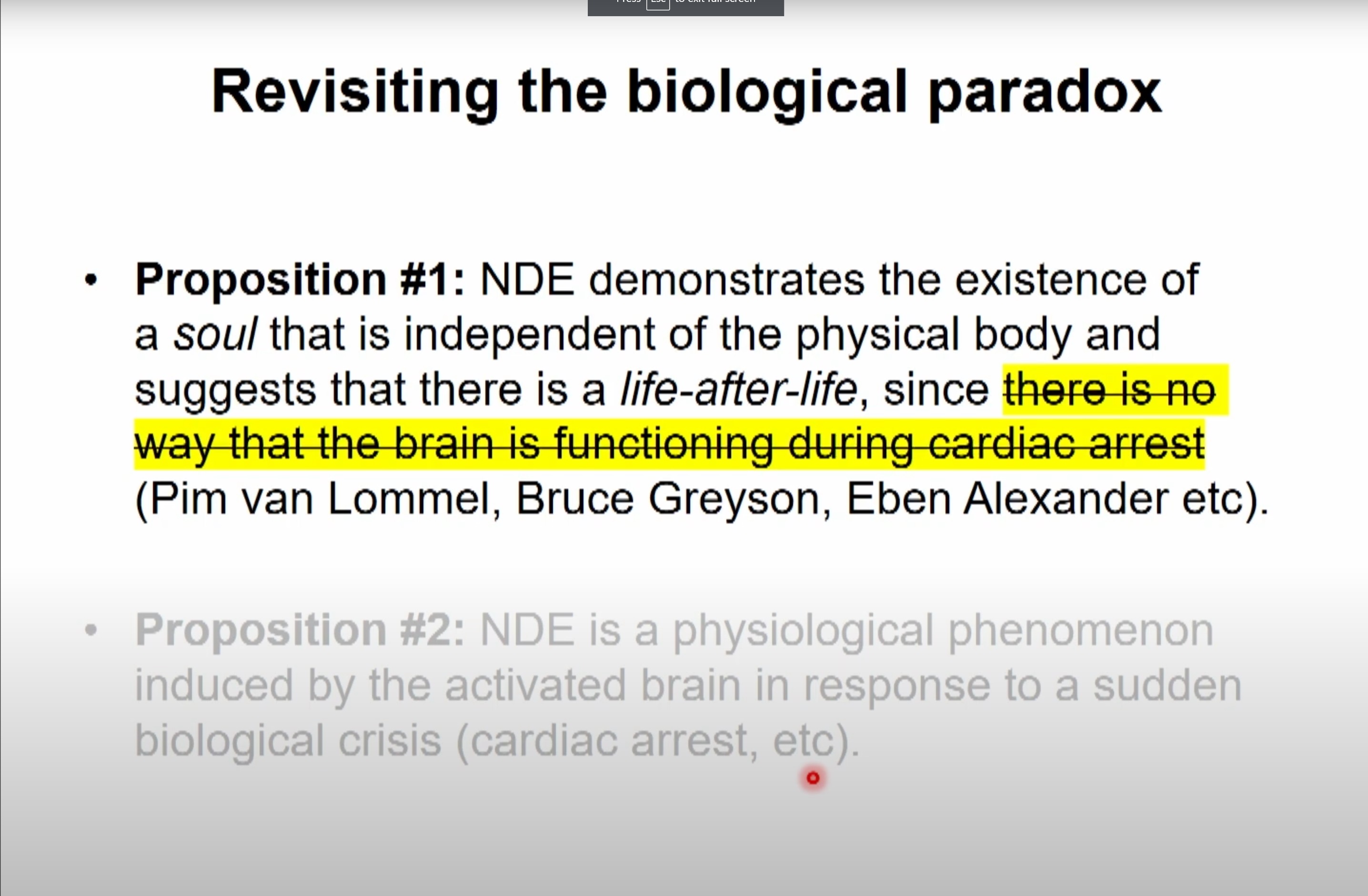
Now I know that the likes of Timmermann approach this from the other way round to the way I suggest that they do, namely that they try to infer that NDEs are just a physiological phenomenon induced by neurotransmitters like DMT trips, and not that DMT trips are like NDEs. This is the reductionist approach, but whichever way round you look at it, the similarities are superficial and do not stand up to scrutiny – the pig is most definitely wearing make-up.
Ultimately my highly speculative view of psychedelics, and while we are on this (and I may do separate posts on these at some point), other NDE-like experiences reported due to syncope or REM intrusions etc, is that they possibly disrupt the consciousness in a way that momentarily causes it to “wobble” within it’s physical confines. This speaks to Parnia’s disinhibition hypothesis (Eduardo – shush) and the idea that there is a physiological mechanism behind the consciousness “packing its bags and leaving” that may be facilitated by certain neurotransmitters. This is highly speculative, but maybe DMT, epileptic fits, syncope etc disrupt the tethers that normally keep the consciousness in place.
Hope you enjoyed. If you did please buy one of my books or buy me a coffee if you haven’t already,

 AwareofAware