EVA in RED
Although we may hopefully be talking about an EVA in RED, it won’t be about this one:

It will be about something far more exciting than the fashion choices of glamorous women!
So I have paid $15 for 72 hours access to this article. That is a bit galling, but probably worth it…and I don’t like pinching other writers material, no matter how much of a rip off it is (click on pic for link):
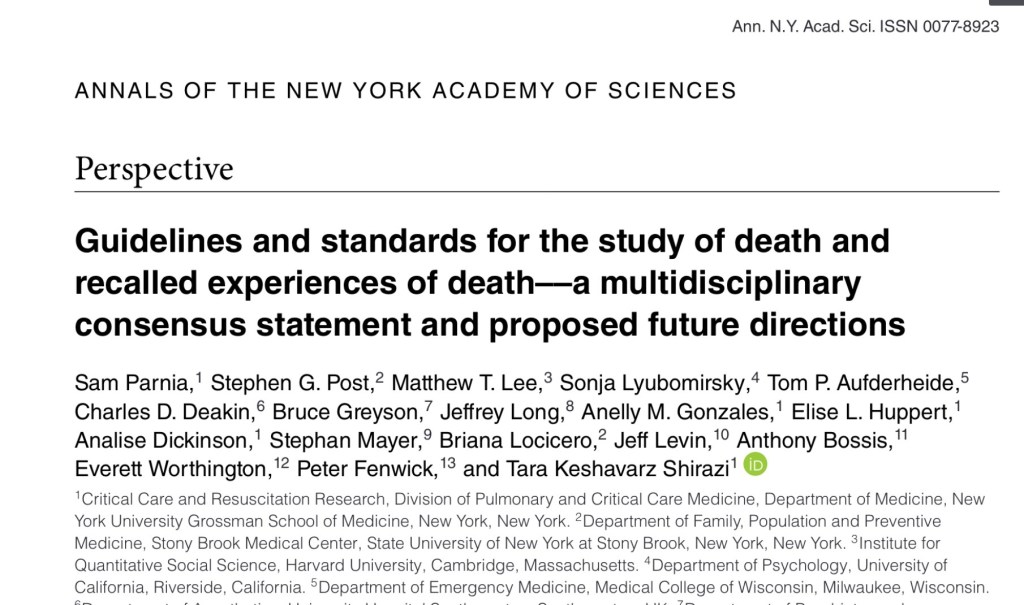
The article is very important as it lays a baseline for our understanding of the subject of REDs (authentic NDEs), creates key definitions for the subject and criteria that meet those definitions, and finally sets out the direction for future research. It is a consensus statement that is authored by some of the top names in the field with Sam Parnia being the first author. It is needed to avoid the kind of nonsense we have experienced over the past few days in which a publication called something an NDE which was in fact only a period of EEG readings from a dying person who never reported an experience.
My first comments are on the two new acronyms that have been created to more precisely define the different reported experiences:
RED – recalled experience of death
EVA – external visual awareness (formally OBE)
I get the need to move away from NDE, but RED? I occasionally work with marketeers to transform medical data into user friendly visuals, and red is a color that is always associated with negativity. For example, when creating a graph, we are never allowed to put a competitor’s data in red as this could be seen as biasing perception. I understand that the words forming the acronym are precise, it is just unfortunate that the acronym itself spells something that is associated with “stop” or “danger”. I know they have been struggling with this for a while, with ADE, TED etc and now RED, but just for aesthetic reasons, it may have been worth persevering a bit longer. I guess we haven’t helped. Either way, we are now stuck with this since it is part of this consensus. So from now it will be RED.
The paper is very long and contains some great material, but the key thing is the tight criteria for an experience to be defined as a RED:
1. A relation to death.
2. A sense of transcendence.
3. Ineffability.
4. Positive transformative effects (relating to meaning and purpose of life).
5. Severity of illness that leads to loss of consciousness (LOC), together with:
6. The absence of features related to other coma related experiences.
More succinctly, a RED “is defined as a specific cognitive and emotional experience that occurs during a period of LOC in relation to a life-threatening event, including Cardiac Arrest”. They go on to state that LOC “relates to assessments from the perspective of a clinician or other external observer, even though from the perspective of the person experiencing a RED, often there was no perception of any LOC”.
They also outline a fundamental narrative for REDs. This was actually something I mentioned yesterday in the comments on the Straw Man…the life review is often at the end of the sequence of events before the sense of returning. The narrative arc is basically:
1. Perceived Death and Separation from the Body.
2. Heading to a “Destination”
3. Reliving the recording of life that is educational
4. Being “Home” again
5. Returning back to life
6. Reported effects after the experience.
This is the basic narrative, but they list a whole range of other facets of REDs that are reported such as meeting a creative source and whatnot.
They then lay out why REDs are distinguishable from other experiences such as ICU delirium, drug induced hallucinations etc and the central theme of this differentiation is in fact the clear narrative that is reported in REDs. I have concerns with that because people could easily “fake a RED” if they know this narrative and happened to have a CA and recover. That comes from my skeptical and untrusting nature!
After laying out the definitions and different facets of REDs and EVAs, they propose future directions in research on subjects such as terminal paradoxical lucidity, and trying to shed light on the underlying neurological mechanisms (if neurology alone can account for these events). They also suggest taking the positive elements of REDs, the transformative aspects and finding a way of generalizing this to helping terminally ill patients cope with end of life.
They end with this neutral statement followed by a summary and key recommendations. While neutral, it most definitely points to the possibility of “other dimensions” that were mentioned on the Instagram post yesterday:
“Finally, we suggest that although systematic studies have not been able to absolutely prove the reality or meaning of patients’ experiences and claims of awareness in relation to death, it has been impossible to disclaim them either. Clearly, the recalled experience surrounding death now merits further genuine investigation without prejudice.”
Overall this is a very useful paper, and will help us in terms of understanding and interpreting future research work published in this field. It is interesting that the “Straw man” paper came out almost exactly the same day…coincidence? The swivel-eyed in me is tempted to think not!
Finally, I do have one big concern with this consensus statement, and I will seek clarification on this. In the 6 criteria that they lay down that must be met to be defined as a RED, they only seem to allow for positive experiences. We know that about 25% of experiences are negative…are they discounting them despite them occurring under similar conditions and including other core elements? If this is the case, I would be very concerned, since it is precisely this kind of “only see the good” thinking that has got us into such a pickle with Putin and Xi. There are monsters. Not everyone is good. There is a heaven, but according to a significant number of RED reports, there may also be a hell, or destruction. Just a thought. Maybe given this emphasis, and their potential exclusion of negative experiences, they should call them PREDs…Positive Recalled Experiences of Death, and how about using BREDs for the others…bad recalled experiences of death. Of course I am being facetious, but the subject is very serious in reality and should be covered fully and without a preference for only the nice stuff.
Anyway, that is my first reaction. I will be reading it again over the weekend, and look forward to your comments on this “line in the sand” that these thought leaders on the subject of NDEs REDs have drawn.
Hopefully it won’t be too long before we do see EVA in RED, and in the AWARE II study.



 AwareofAware