Podcast on Origin Of Life
I know it is not NDE, but its related to the nature of reality so if you are interested in this fascinating subject, and my views on it after writing a book on the subject (DNA:The Elephant In The Lab), then please click on one of the links below and listen/view Darren and I discuss this subject. The evidence is extremely clear…life could not emerged by random natural processes and was most likely the result of intelligent initiation:
YouTube – https://youtu.be/QV6IfrAfQ_Q
Spotify – https://open.spotify.com/episode/29cO91HyuQVPZs6rkPKaRJ?si=Gh89UZXrRfijiVonQrWgkg
Also please sign up to Darren’s Patreon site. He creates a lot of excellent content on subjects that are of interest to many of us on here.
YouTube memberships: https://youtube.com/@SeekingI/join – Early Access, Access to Discussion Groups, Access to Exclusive Non-Podcast Videos.
Patreon: https://patreon.com/c/SeekingI – All the above minus the non-podcast videos
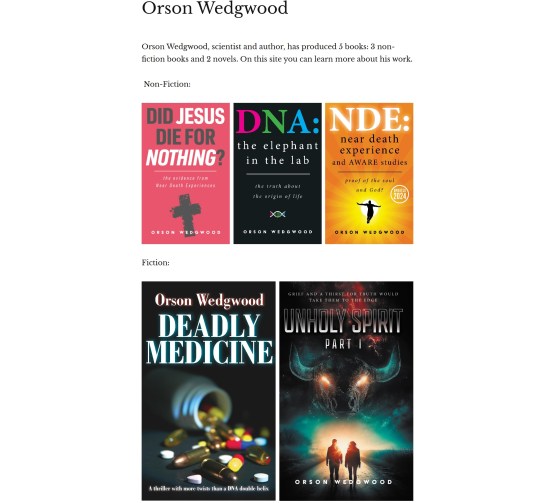
Finally, as always, if you haven’t already, please support what I do here by buying (and reviewing) one of my books by clicking on the image below:

 AwareofAware
Sounds interesting! Thanks for sharing!
This has also something to do with the origins of life. Interesting read and I would love to know your thoughts about it.
https://closertotruth.com/news/consciousness-came-before-life/
LikeLiked by 1 person
Darren has a good podcast. I’ve been watching Seeking I podcast since the beginning
LikeLiked by 1 person
Wow didn’t know Seeking I was on Spotify! Thanks for the tip, I’ll be back with feedback on your second appearance! I’ll try finding the source, but I enjoyed reading an agnostic website on evolutionary biology a couple months ago. The author, a scientist in the field, was talking about some sort of vital force in cells and particles. I also recently listened to a podcast on cell “intelligence”. Fascinating subject.
LikeLiked by 1 person
“Vital force” lol. My talk avoids evolutionary biology, although I do get into pre-LUCA (last universal common ancestor from which all life came) biochemical evolution. The principals are very similar:
1. The mutation (s) in the system has to confer sufficient survival advantage that it will outperform existing variants.
2. Evolution has no foresight – it doesn’t, have a plan, it is blind, it is unable to predict advantage.
3. Systems cannot tolerate more than a couple of mutations in their genetic code as the vast majority of mutations are fatal, harmful or do nothing, so if you have more than a few mutations the chances of not having one that damages the organism become vanishingly small.
Darwinian evolution struggles to overcome these barriers when it comes to the emergence of new phenotypes or species. In the biochemical world, it is utterly absurd to believe that blind evolution could produce the code for making a cell wall, or in fact produce a code in the first place. I go into great detail in my book explaining why the attempts to explain things, such as the RNA world, are “scientism” they explain nothing.
LikeLike
Vital force was my own bad wording lol. The author is Stephen L. Talbott from Nature Institute. Here is the question underlying his work : “How do molecules gain whatever passes for their “awareness” of — their ability to interact intelligently in light of — the meanings of the larger cellular and organismal context in which they find themselves? The problem is that making the question explicit is enough to show that it does not sit comfortably with the acceptable explanatory apparatus of today’s biology.” He refers to ideas that are similar to the fine tuning argument in cosmology, stating how improbable this could all happen randomly/by chance. He’s also very much against the idea of a cell being like a machine.
I have an hard time pinpointing what he believes in since he seemingly challenges materialism, panpsychism and intelligence design lol. His criticism of ID is interesting though, he remains opened to it.
I haven’t listened to your episode yet but looking forward to it. I’m currently reading Matt Colborn’s What lies beyond book. I find myself coming back to books/podcasts about the greater meaning of life!
LikeLiked by 1 person
Seeking I is à good podcast. Im featured on episode 91. Darren isxa good host. There’s also what the f just happened podcast hosted by Liz Entin abd Unraveling the universe podcast hosted by Ben Sinclair
LikeLiked by 1 person
He is a good host. He let me blather for on at will 🙂
LikeLike
Thoughts?
“A quantum microtubule substrate of consciousness is experimentally supported and solves the binding and epiphenomenalism problems”
Neuroscience of Consciousness, Volume 2025, Issue 1, 2025, Michael C. Wiest
https://academic.oup.com/nc/article/2025/1/niaf011/8127081
LikeLike
why isn’t this in the news? This is pretty important especially since the scientific community had been so dismissive of orch-or at first.
LikeLiked by 1 person
I have no idea. That’s why I had to post it here!
LikeLike
I will have to read it more carefully, but the main reason it’s still not accepted IMO is that while there are some evidence, most is very preliminary and often based on tools that are themselves preliminary and subject to criticism. Physicists are also very cautious when non-physicists write about QM. Even Hameroff himself is often portrayed as an opportunist con-man on different blogs and discussion threads. Add to this a layer of metaphysics of consciousness… I personally think it looks promising as a theory, but it is still too soon to judge!
LikeLike
Hameroff is not a physicist but his partner Dr Penrose is and a Nobel prize winning physicist no less. But I suspect what you say is mostly right. We can’t jump on the first preliminary result and start proclaiming as if though it’s true. There is nothing wrong with being skeptical and waiting for the facts to come out.
LikeLike
Pablo, I agree about Penrose and would even add that the guy is a genius. But even being a genius didn’t stop angry atheists like Blackmore or Hawkins to criticize him for playing outside of his field. Hameroff stirs a lot more criticism though because he’s far more prone to formulate conjectures concerning what this theory could mean for things like survival or reincarnation, but also even Darwinian evolution. Penrose is more of a pragmatic idealist (if this is a thing lol) akin to Plato. He’s a proponent of mathematics being fundamental to reality, independently of the physical and the mental (two other independent realms in his view). We’ll see how things unfold since experimental results are promising and both current “bests” theory of consciousness kinda sucked when tested against one another.
LikeLike
Definitely interesting stuff!
LikeLike
Your paper references another paper from 2024 by Nathan Babcock et al, which is interesting (and I had missed). It demonstrates evidence for Tryptophan/microtubule network Superradiance; Long-lived coherence even in thermal disorder; And scaling of Superradiance with Microtubule (MT) length and number:
https://doi.org/10.1021/acs.jpcb.3c07936
[ Note about Superradiance: it is a quantum optical phenomenon where a group of excited atoms or molecules, coherently coupled through their interaction with a common electromagnetic field, collectively emit photons at an enhanced rate compared to independent emission. This cooperative effect, first described by Robert H. Dicke in 1954, arises due to the synchronized behavior of the emitters, leading to a radiation intensity proportional to the square of the number of emitters (N²), rather than the linear dependence (N) seen in spontaneous emission.Key features:
This adds more evidence of suitable natural isolation in the ‘…warm wet brain…’ for quantum coherent processing.
When taken together with Mikheenko’s work showing Meissner-like expulsion of magnetic fields by hydrated MTs – suggesting a superconducting-like shielding mechanism against electromagnetic decoherence, enhancing the survival of quantum effects at high temperatures.
And Bandyopadhyay’s work on hydrated MT’s showing their ridiculously low metal-like 1-ohm resistance at 8 MHz, which crucially was found to be both insensitive to changes in temperature and MT length, again, indicating superconducting-like properties.
LikeLike
Have you looked into the stuff from EssentiaFoundation? Could be interesting to you! @Max_B
LikeLiked by 1 person
Would evidence to this mean we are just matter in the end or that there is more than matter? I find this mumbojumbo scientist language very confusing. Anyone willing to explain it to me the simple way?
LikeLike
This is pretty amazing.
https://www.scientificamerican.com/article/how-to-detect-consciousness-in-people-animals-and-maybe-even-ai/
LikeLike
I finally listened to the episode, great job! Made me realize I’ll have to do some serious catching up concerning chemistry, spent too much time on physics and psi research lately. I’ll get your book to get a more in-depth dive into the subject. Fine tuning-like arguments are often criticized by reductionists/physicalists/materialists. Either they invoke probabilities (like the effect of large numbers in anomalous research) or theoretical concepts (various theories for the origins of the universe, for example). My knowledge helps me weight in the evidence in physics (a fair bit) and psychology, but much less in chemistry. Do you mind explaining how you respond to critics like this one : https://www.talkorigins.org/faqs/abioprob/abioprob.html#Intro to help me out? Thanks!
LikeLiked by 1 person
Sorry, but that paper is total nonsense. No one says that we go straight to a bacteria, but when he says things like there are self replicating proteins or nucleotide polymers, he is lying through his teeth. There are molecules that have been able to replicate a small portion of themselves, but there is no fully self-replicating molecule for the reason I sate in that interview. He shows a picture of a protocell with a lipid membrane, how does that it get in the code? No answers ever? When it comes to the statistics, again he is wrong, but it takes pages to explain why. He also describes a soup which is churning out billions of these chains…it’s all just complete garbage.
Anyway, I don’t really bother with this stuff much more for the very reason that you get endless people saying “what about this paper that says that” and then you look at the paper and it says nothing…always. People can believe what they want, and most choose to believe a complete fabrication.
LikeLike
Excellent response Ben!
This is what we are continually having to respond to – nonsense from the scientific materialists who cannot stand having their sacred ideology exposed as untrue.
LikeLike
Thanks for the reply! I’m sorry if it bothered you, I assure you my goal was only to get your take on a critique so I can see where the skeptics in the field do their usual stuff : ridiculize, overstate/exaggerate findings and knowledge, make generalizations that don’t really apply, etc. I hate how vulnerable I am to skeptics’ attacks about being naïve or stupid. It really hits me when it’s outside my knowledge base lol. The more I read the more I see the most vocal skeptics are often either generalists who don’t have much precise knowledge about a topic or advocates of a certain ideology in a given field. Wish I had that bold confidence, yet I think humility is very important in my field (mental health). Anyways, thanks!
LikeLiked by 1 person
Any irritation expressed in my response was not directed at you but at the paper you cited, and you characterised its flaws well. They say that these systems evolved from simpler smaller components, and yet such a path has never been described and smaller components do not work. Anyway, it is not a battle I really choose to fight. The only reason I wrote the book in the first place was because I was encouraged to by some Christian friends after I gave a talk at church as to why I, a Ph.D. scientist with an in depth knowledge of the molecules and systems that lie at the heart of life, and always have, believe in God and why I am certain that life could only be the result of an act of intelligent will.
The NDE argument is much simpler and black and white.
LikeLike
Parnia has surfaced on Twitter and You Tube with Jesse Michaels of AlchemyAmerica
LikeLiked by 1 person
Got a link?
LikeLike
google Jesse Michael’s Alchemy American
I don’t know how to link on this ….
LikeLiked by 1 person
a big thank you for this information! i did read everything and learned many new things. im sure not everything is 1:1 like parnia said it or meant it (im still scarred by the media respresenting his words in a false way) but jesse is very positive and is not trying to ridicule any of what has been said by parnia. he tries to represent it nicely.
LikeLiked by 1 person
Hey Ben! I know it’s not 100% on the topic of origin of life, but I was wondering what you think of Michael Levin? He gives me the same vibe as Parnia ie testing the waters with stating more “bold” hypothesis concerning life, consciousness, etc.
LikeLike