AwareofAware

Evolving news on the science, writing and thinking about Near Death Experiences (NDEs)

Archive for the tag “Near Death Experience”

What are the chances?

This article was posted by Maria in the comments of my last post. Thank you.

Link to article on how to capture visual OBEs

The original article is over 30 years old, and this fact alone highlights just how long we have been waiting for a scientifically verified visual OBE in a research setting. When I say scientifically verified, I mean that a hypothesis is generated, an experiment devised to test that hypothesis, and a positive result recorded within that context. I have taken great pains over the years to point out that adherence to the scientific method is central to insuring the credibility of any results that emerge from a study seeking to verify OBEs or NDEs.

The hypothesis would go something like this:

The consciousness is able to persist and separate from the physical body once the heart has stopped beating and brain stopped working, and observe events externally from the body.

The experiment would then test this hypothesis by creating a method by which the ability to observe events during this state is assessed. This paper describes the type of visual stimuli and location that would be best, based on interviews of people who reported OBEs during their NDEs. Presumably Sam Parnia read this article as a reference for designing this aspect of the AWARE study. He placed cards on shelves near the ceiling in various ICU wards in different hospitals. Despite there being a total of thousands of these cards dotted around hospitals all over the world, none of the reported NDEs from AWARE 1 occurred in a room with a card. The reasons for this have been discussed multiple times before. While reports of NDEs are very common, deliberately setting out to prospectively observe patients who have a CA with an NDE and an OBE and who then survive long enough to be interviewed is extremely difficult. Reports of murders are common, but if you set up an experiment to try to witness a murder, it would be very hard. Maybe a clumsy analogy, but my point is that while a random event may occur commonly, being able to deliberately observe that event may not be straight forward.

This problem has also plagued AWARE II despite its updated methodology and slightly tighter inclusion criteria, and based on the preliminary data presented at AHA in December 2019, it seems unlikely that when the final results are published that there will be a verified visual hit. This quote from the article’s conclusion predicts our torture all the way back in 1988:

the process of accumulating sufficient data in hospital veridicality research may be protracted

No kidding!

There is another problem with the AWARE studies. The above hypothesis that I state is not specifically included in the study, and the studies are not designed with the specific intent of testing this hypothesis. Testing this kind of hypothesis may have been Parnia’s original intent when he started out, but possibly for credibility reasons, he has not been able to explicitly state this in the study designs. The studies have therefore been hampered in their ability to achieve the outcome of proving this hypothesis as a result. If there is a scientifically verified OBE it will be a byproduct of the research in that the stated aim of the visual and auditory experiments is to better understand the nature of reports of conscious awareness rather than prove the above hypothesis.

Finally, any publication that Parnia submits will need to be peer reviewed. Peer review is far from a flawless process and is subject to the personal biases of the reviewers. Given the hostility in the materialistic scientific community to research that might challenge the prevailing materialistic orthodoxy, any evidence that Parnia presents to support this hypothesis will scrutinised very closely and potentially arbitrarily dismissed by reviewers. We only need to look at the COVID lab leak vs natural emergence fiasco to know without doubt that the scientific community is capable of subverting the truth if the truth challenges their preferred narrative.

Given all of this, I am becoming quite gloomy about the prospect of the paper that presents results from AWARE II including any scientifically verified OBE. It is due in the next few months, so we should know one way or the other.

NDE, RED, REX – is it all just a case of Timantics?

Apologies for the pun, but couldn’t help myself. As some of you may be aware one of the more valued members of this site, Tim, and I had a somewhat acrimonious discussion yesterday that became personal and resulted in Tim saying his goodbyes. Goodbyes, unlike death, can be reversible, so hopefully we will see him again and continue to learn from his outstanding knowledge of this subject.

So what was all the fuss about? For me it was a case of semantics – in this instance the meaning of the word death and its use in the term RED. The reason for us discussing what the word death means was due to this article:

Studying death and near-death experiences requires neuroscientific expertise

First of all, the title is ludicrous and based on a huge assumption. The study of NDEs only requires neuroscientific expertise if NDEs are the result of neurological processes. I have spent the past 4 years of my life working in neuroscience, and I can assure you that there is nothing in human understanding of neuroscience that could explain a genuine OBE. That has and always will be the issue, therefore the study of NDEs does not need an expertise in neuroscience. It might benefit from it to interpret various neurological measurements that are acquired during a CA, but it is not necessary, especially when it comes to any experiments that attempt to validate OBEs. If you have a scientifically validated OBE, then that cannot be explained by science. Moreover, neurologists and neuroscientists were a part of developing the consensus statement.

Obviously starting off with the assumption that an NDE is a natural neurological phenomenon means that the rest of the article is constrained by this materialist assumption and therefore many other things that are said are just incorrect. However, there are a couple of points they make that are very pertinent and worth highlighting, and one in particular that caused the spat between Tim and me. It was my suggestion that I agreed in part with their statement about the use of term RED that set things off. This is what they said:

Second, contrary to what Parnia et al. write, people who recall NDEs are therefore inherently people who have not been dead and have not met brain death criteria. Since the introduction of brain death criteria in 50 the 1960s, not a single patient properly diagnosed as brain dead has come back to life….Because of these scientific inaccuracies, the proposed term “recalled experience of death” is wrong and we firmly reject it. The authors confuse “death” with the process of dying

My initial response of agreeing in part was more a gut reaction given that I was not aware of there being specific definitions for death and therefore given this state of affairs, and given the potentially reversible nature of the condition people are in when their hearts and brains have stopped functioning, stating these people had experienced death seemed a bit of an over reach. This gut reaction is reinforced by having watched all these TV shows in which the ER physician announces “time of death” when they give up CPR…i.e. the person is beyond medical help and the process of dying has become irreversible.

As the discussion continued I started looking into definitions of the word death. Dictionaries and on line resources tend to use the word irreversible, but what really nailed it for me was the UDDA definition which is used in the US:

The Commission ultimately recommended a Uniform Determination of Death Act (UDDA) which aimed to make the total brain standard into law in the states. This recommendation has been adopted by the American Bar Association and American Medical Association, and made into law in some form in all 50 states. The UDDA simply states: ’An individual who has sustained either (1) irreversible cessation of circulatory and respiratory functions, or (2) irreversible cessation of all functions of the entire brain, including the brain stem, is dead. Sarbey B. Definitions of death: brain death and what matters in a person. J Law Biosci. 2016 Nov 20;3(3):743-752. doi: 10.1093/jlb/lsw054. PMID: 28852554; PMCID: PMC5570697

In Canada: Death occurs when there is permanent loss of capacity for consciousness and loss of all brainstem functions .  This may result from permanent cessation of circulation and/or after catastrophic brain injury. In the context of death determination, permanent refers to loss of function that cannot resume spontaneously and will not be restored through intervention.

Now while this is adopted in the US and Canada, it is by no means globally adopted, and there is still uncertainty about the exact moment that the word death is appropriate, as evidenced in this NHS presentation on the subject: http://odt.nhs.uk/pdf/Diagnosis_of_death.pdf

For me the key quote in that discussion is the following:

Dying is a process; Death is a defined point in that process

This is the point that the article by Martial is making, and while it is a semantic point, it is central to the consensus paper and Martial is right to call them out for coming up with the term RED – recalled experiences of DEATH. Basically, using the dictionary, US legal, Canadian and wider medical community’s definition of death, someone who has achieved ROSC has not experienced death. Oops.

Now I understand why Parnia et al came up with the term, and I somewhat agreed with it in principal at the time, but my view has now changed, and I think theirs should too…although that is harder as they might need to retract their paper which is a pretty hideous thing to do from a researcher perspective. NDE is actually the most accurate term, and while it has been abused by people broadening its application from the one originally intended, it would be better to apply clarifications such as authentic, or classical, rather than completely discard it. In fact their recent attempt to completely change the meaning of the term NDE to not include REDs was something that I really objected to.

But it is all just semantics. Fundamentally, while the term RED is technically wrong, we know exactly what condition they are describing: it is a condition in which the body is completely incapable of consciousness and in which the brain is incapable of producing or storing conscious recollections, and yet people report experiences occurring and have been able to “prove” these through human verification. This is why I say I partly agree with Martial et al say, because otherwise much of way they say is complete hogwash. For instance:

There is hence no “recalled experience of death”; if anything, it should be ‘recalled experience of what might have been the start of the dying process just before consciousness was lost’.

Technically they might right in saying that it could be the start of the dying process, but by adding “just before consciousness was lost” they are betraying their materialist bias. That is an assumption, and the whole point of doing these studies. While they have a point in saying that studies have failed to empirically prove [beyond any doubt] that “people are able to report actual (real-life) events and details happening during e.g., cardiopulmonary resuscitation” neither do these studies, or any others disprove it. Moreover studies such as AWARE I and others, while not providing slam dunk proof, provide very strong evidence supporting the thousands of reports by very credible people, including Health Care Professionals, outside of the context of a clinical study.

Their third point is another tricky one and I find myself agreeing with a part of it:

“Third, the authors write that NDEs in post-cardiac arrest patients fundamentally differ from NDEs made in other life-threatening or non-life-threatening situations, and that the latter experiences are “mislabeled”. Again, the reasoning is flawed. There are no empirical data so far to indicate that the phenomenology of NDE differs in situations that are (a) associated with a threat to life and impaired brain physiology such as  a cardiac arrest, (b) associated with a threat to life but unimpaired brain physiology such as a near-miss traffic accident, and (c) associated with non-life-threatening situations such as drug consumption or  meditation. To the contrary, the data that do exist indicate that all these experiences are phenomenologically  similar (e.g.,12-16). In other words, from the phenomenology of the experience one cannot tell if what happened was a cardiac arrest or e.g., use of a psychedelic drug. Contrary to what the authors state, this similarity suggests that the brain mechanisms behind these experiences are probably also similar, if not identical.”

I agree somewhat with their stating that some aspects of NDEs overlap with other experiences reported in different states. However, there are two ways of looking at this. The first, and one they cite, is that these experiences are the result of similar neurological processes, and the second that these experiences are possible in a variety of states and speak to the ability of the human consciousness to momentarily detach from the physical body. Both, in the absence of scientific, or empirical evidence, are possible explanations, but Martial et al only countenance one, and this is neither objective nor scientific. Moreover, the different conditions they cite are unlikely to produce similar neurological states and therefore it is unlikely they would produce similar psychological outcomes or recollections.

They make a few other statements based on their assumption that NDEs are the result of physiological process, which must be viewed in the light of this unscientific bias. However there is one statement they make that I absolutely 100% agree with, and which has troubled me enormously, and which I have commented on myself previously in this blog.

“Although Parnia et al. question the existence of distressing NDEs which they consider “related to [intensive care unit] delirium, delusions, and dreams in response to toxic metabolic states and withdrawal states (e.g., alcohol withdrawal)” (p. 17 of 127 File S2 from1), the latter claim is not empirically supported.”

The paper that Parnia cites to make this assertion actually suggests the complete opposite. I think this comes from a fundamental flaw in Parnia’s character…he is too nice! He doesn’t even want to consider the idea that people suffer after they die. I get that, but I do not believe that his position is the right one, and explain why in my book.

As for the conclusion of the article:

“Although (near-)death research certainly merits a framework directive, the paper by Parnia et al. is subject to a surprising lack of neuroscientific understanding. It reflects the fact that the field of NDE research (at least in parts) is biased by a widely held belief that there is something fundamentally special, if not supernatural, about NDEs, such as the notion that humans can have conscious experiences in the absence of a functioning brain.”

Yep, that’s the whole point isn’t it, and in the absence of scientific proof that consciousness in the absence of a functioning brain is not present, it should not be discounted as a possibility, and to do so is unscientific. The above statement displays a whopping lack of self-awareness when it comes to understanding their own lack of objectivity.

In summary, I think Parnia et al may need to rethink the use of the term RED. They also need to be aware of their own potential bias, such as on the subject of negative NDEs, and be open to outcomes that might be unappealing, but are nonetheless possible.

AWARE II: 15% of people had REDs

This is the first time I think that Dr. Parnia has mentioned any specific numbers from the forthcoming and much anticipated publication of data from AWARE II. A nice teaser quote from the UK Telegraph this weekend:

“Dr Parnia said soon-to-be published research will show that around 15 per cent of people who have been resuscitated from a coma after cardiac arrest have a Recalled Experience of Death.”

Daily Telegraph, 7th May 2022. Sarah Knapton, Science Editor

Link to latest AWARE II teaser

(it is behind a paywall, and given it is mostly a summary of the consensus statement and the state of the field, useful and informative to the wider public, but won’t be news to most here – except for the quote I have given)

Of course it is possible that this could be from his other research which from my understanding is a retrospective database analysis of reports they have collected from NYU and other establishments over the years, but I don’t think he would necessarily be able to state such a well defined number since, unlike AWARE II, that work is not a prospective study that looks at incidence of NDE among all those who survive a CA. Moreover, the fact that he has been trailing the publication of AWARE II for months now, would suggest it is from this study.

I think this is very important as I assume that he will be using the new criteria for REDs to differentiate from other experiences. It also significantly increases the chances of a “HIT”…by about 50% in fact. Given the rigour with which his team at NYU are conducting this research, I think that 15% will become the established number…provided the wider survivor cohort is sufficiently large.

I also think it is really important to consider that OBEs have largely been redefined as EVAs (external visual awareness), which by their very definition require VISUAL recollections. For a long time here we have been discussing the possibility of auditory OBEs , but in the consensus paper these are only mentioned in the context of accompanying an EVA and not a significant phenomenon in its own right.

There are some good NDEs in the comments section of the telegraph article, including one from a chap who had 3 CAs but only produced a single RED. This has been reported before on numerous occasions and points to Dr Parnia’s assertion that most, if not all, people who die and are resuscitated have an NDE (not a RED), but most can’t recall them due to physiological and/or biochemical reasons (which is why they aren’t REDs). This undermines one of the theories I state in my book, which I would be very happy to see undermined as it is not all that pleasant!!

Reminder in the link of my book which I recently updated (available amazon globally). I will be writing another update post AWARE II publication which, in addition to analysis of the new data, will include adjustments and additions to the possible theories as to why 80-90% can’t recall their NDE. This will reflect some of the excellent analysis provided on this topic in the consensus paper.

Link to my book on the AWARE studies

Really good to see the MSM, particularly a respected broadsheet like The Telegraph, take this seriously and report it in a balanced objective manner.

“This time next year Rodney”

We come to that time of the year again when we look back at the past year and rue the lack of new data, and look forward hoping that this year will be different. We are like the characters in the 1980s UK hit TV show, Only Fools and Horses featuring Del Boy and Rodney Trotter, who lived in a state apartment in a poor part of London and were always coming up with schemes to make themselves rich, but never succeeding. “This time next year Rodney,” Del boy would say to his younger brother, “we’ll be millionaires.” It was either this analogy I was going to use, or Groundhog Day…both fit the feeling I have about the AWARE II study despite the promising Tweet made just after New Years which stated:

“We hope to see you in 2022 as we ring in the New Year with exciting news, including updates on the AWARE II study!

This has been followed more recently by some Tweets on the study that looks into paradoxical terminal lucidity in patients with Dementia. I currently work in Dementia as a medical scientist for a Biotech with “skin in the game” so to speak. Also, I watched my father die from Dementia, so I am very interested in this study. I have spoken about this in previous posts, so won’t say any more for now.

On the promise of “updates on the AWARE II study” I am now very cautious about raising my hopes too much having experienced so much disappointment over the years. My expectations range from a statement saying they have more hospitals recruiting patients, to a paper, or conference abstract that provides more details on the different auditory experiences they reported at AHA 2019. The latter has the potential to be extremely important, although I doubt the media or wider scientific community will regard it in such a light. It is clear that Parnia does not believe that CPRIC (CPR induced consciousness) or blood flow from CPR could produce NDEs. I was not certain of this until I read the essay that he submitted to the Bigelow competition (more on that in a moment). It is possible that the update from the AWARE II study includes data from EEG and ECG matched against one or more of the reported auditory OBEs. This could be the smoking gun. Like I said, the scientific community may not accept it as such without a lot of persuasion.

The Tweet trailing “exciting news” was not just confined to the AWARE II study though. It is possible that data may be presented from AWARE III, the study looking into OBEs reported during hypothermic surgery. They recruited their first patient in August 2020, and it is possible that they have been recruiting a number each month, and if that were the case, I would fully expect to have a hit by now.

Who knows, but watch this space, or sign up directly to their Twitter feed.

On another note, I was able to read Sam Parnia’s essay over the Christmas holidays. It was a robust defense of the argument supporting NDEs and as well as going over a lot of old ground, I feel he made a lot more of the hit from AWARE I than he previously has, specifically stating that this is the only time in a clinical study that recollections from an NDE have been corroborated by attending HCPs AND that these recollections were time stamped to prove that they were from a time that the patient had no heartbeat. In some ways this made me feel a little concerned that this would be his “forever hit”, and that from his standpoint no more evidence is needed. From a proof standpoint, I somewhat agree, but then I would, it’s the wider scientific community that demands more.

He also provided a very good argument, supported by data, that CPR could not produce the lucid kind of experiences described in NDEs as CPR does not produce sufficient blood flow, and the EEG patterns associated with CPR do not correspond to consciousness. As others have noted in previous discussions, this puts to bed any doubts around CPR causing the auditory OBEs in AWARE II despite this going against the line that he put in his AHA abstract, so I look forward to any publication that goes into this further. He also discussed CPRIC which is a completely different phenomenon, and is when the patient achieves consciousness during CPR, normally as a result of brief restoration of heart beat. This kind of event is always associated with confusion and distress, and completely different from the kind of recollections that feature in an NDE.

Anyway, I will once again draw deep on my reserves of hope that we will learn of that illusive hit before too long. To me it is inevitable, and judging by the Tweets, the Parnia team also believe it is inevitable, otherwise why would they be so assertive in claiming that CA survivors can recall details from the time they were beyond the threshold of death?

Answer to Oxygen levels and OBE report question – sort of

The second video on the page in the link below is a recording of Grand Rounds from March 2020, which for some reason, I had missed until recently.

Link to videos from Parnia lab

This video should be compulsory viewing for anyone who is interested in a scientific overview of NDEs, the AWARE studies and the work of the Parnia lab. It really highlights to me how amazing Sam Parnia is in terms of his persistence, his thoroughness, his balance, and his humanity in his approach to this subject. Lot’s of amazing tidbits in this video, including anecdotal accounts of NDEs, some discussion around explanations (or lack of) for consciousness and the philosophy of it all. Remember, this is in the context of Grand Rounds at one of the world’s leading hospitals…not a meeting of your local chapter of IANDS. This is one of the world’s leading scientists on the science of consciousness during “death” speaking to fellow physicians and scientists.

Anyway, the reason I made a post about it is that I get an answer to a question that has been bugging me for ages, namely the link between R02 (blood oxygen in the brain as measured by brain oximetry) and episodes of conscious recollection. I have repeatedly tried to get some comment from Dr Parnia or one of his research colleagues on whether any of the reports of sufficient oxygen levels to potentially experience consciousness were correlated with reports of auditory OBEs or other conscious recollections, or not. In this video, at about 50 mins, one of the attendees at rounds asks a similar question, and Dr Parnia replies that there is currently insufficient data to comment on that. That’s why it is only sort of an answer.

This was a year ago. It’s hard to assess how much impact COVID has had on AWARE II, but if they were going by their original study plan, they would have completed recruitment by now and be writing it up. Hopefully we won’t have too long to wait before we receive a full read out from this study.

Data from Parnia Lab at AHA Nov 2020

Last year Sam Parnia presented the first data to come out of AWARE II with the suggestion that validated auditory OBEs had been recorded. I was hoping that we would see something that expanded on that initial report this year, but so far the only data that has been registered from NYU with his name on it is abstract 314 “Cardiac Arrest Related Cognitive Activity” By Tara Shirazi and Sam Parnia, which will be presented this Friday.

I found it through downloading the AHA conference app and searching for him, and the link the app spits out doesn’t work, when I find one that does work I will add it here (now below). The abstract is interesting though nothing groundbreaking. It is a retrospective analysis of patient reports of consciousness after Cardiac Arrest. These were held in a registry of CA survivors. There were 118 reports of consciousness (out of how many we are not told although the numbers 10-20% are mentioned at the beginning), and the reports were analyzed and various themes identified. The usual NDE motifs cropped up – like tunnel and life-review. OBEs were reported in 40% of the cases, which is higher than the previous reports of 25% of NDEs having OBEs. Maybe because this was a situation of patients self-reporting outside of an observational study, they only felt the need to do this if the experience was particularly notable, and having an OBE would definitely make it notable.

It is possible that there will be a late breaking presentation by Sam Parnia, but at the moment it doesn’t look as though AHA 2020 is going to give us anything new on the NDE front.

https://eventpilotadmin.com/web/page.php?page=IntHtml&project=AHA20&id=ress27

More data from AWARE II(maybe), news on AWARE III and my book.

It’s been a while, so I thought I should post some thoughts and updates. In terms of the latter, this has been a very quiet year, not just from Sam Parnia, but in general on the subject of NDEs. Of course everything has been overshadowed by COVID. Most conventions or scientific meetings have either been cancelled or held virtually.

I recently attended a virtual European convention on sleep science, and it was an illuminating experience. In some ways it was better – no airport security queues, or late night rides in a smelly taxi to soulless hotels where I would be away from my family for days on end. I found I was able to interact with other researchers quite well when they were presenting data, and I was able to look at the things I was interested in at my leisure – while wearing very casual attire. However, in general it was vastly inferior to an in person convention, and while my job was already one that was done partly from home, and in future things will be a hybrid, I cannot wait till I am able to get back into the hospitals and universities to meet with physicians and scientific researchers face to face.

As a result of this year, many of the meetings where someone like Dr Parnia would present have not occurred in the normal way, and when you google him, or the AWARE study, most of the links come from previous years. The truly awful Daily Express seems to create recent links to a rehashed story on Dr Parnia explaining NDEs in terms of something that can be explained by physiological means, but I have never heard him say that in a meeting or in a written article. However, he did just publish a paper exploring the link between cerebral oxygen levels and neurological outcomes after Cardiac Arrest (CA). The abstract published in last month’s Resuscitation does not hint at any data on consciousness, so I am going to withhold my $36 to buy the full text, although if we continue to experience this NDE news drought, I may well go ahead and buy it! There was data he presented at AHA last year that did seem to hint at a possible link between conscious brain activity during CA and oxygen levels, so I suspect this new data may have come from his AWARE research group – hence the teaser of data from AWARE II in the title! (I know, somewhat tenuous, but these are desperate times for an NDE research blogger!). The link is here:

The association between post-cardiac arrest cerebral oxygenation and survival with favorable neurological outcomes: A multicenter study

So other than this, we have been left with Sam Parnia’s very quiet Twitter feed and the Parnia lab website which has been updated as the year has gone by. The most significant thing to come out of that has been the announcement of the commencement of the study on awareness during deep hypothermic circulatory arrest. This is in essence the COOL study mark II.

The COOL study was set up in Montreal at the beginning of the last decade and designed to investigate reports of NDEs and OBEs during deep hypothermic cardio circulatory arrest. Out of 33 returned questionnaires, 3 reported conscious mental activity (very much in line with the 10% reported from CA NDEs) one veridical OBE report was made from this study in which a young pregnant woman reported seeing various instruments that were behind her head, and was later verified by hospital staff (VOLUME 83, ISSUE 1, E19 2012. Conscious mental activity during a deep hypothermic cardio circulatory arrest? Mario Beauregard). The study was retrospective and did not have the kinds of experiments built into it that could prove an OBE. This is where Dr Parnia’s study is different since it is prospective and uses the same equipment that is used in the AWARE II study. I am dubbing this new study the AWARE III study, since it falls under the same AWARE research umbrella. As I have mentioned in previous posts, this study has a lot more chance of eventually getting “a hit” than AWARE II due to the controlled conditions (vs a random CA in an ER unit), prior patient awareness of the presence of the iPad and most importantly, the chance of surviving long enough to be interviewed. Dr Parnia tweeted that the first patient had been recruited in July of this year.

For a while there was a bit of confusion over whether AWARE II had wrapped up, partly due to one of the research portals saying recruitment had closed. However, on the Parnia Lab website it states that recruitment is still ongoing, and indeed they are looking to expand the number of research centers over the next two years.

So one day we will hear more from AWARE II or III. It may not be till next year now due to all the delays in everyone’s lives, especially someone like Dr Parnia who would have been in the thick of things earlier this year (although if he is anything like ICU and ER physicians I know in the UK, he will have had the quietest summer of his career!).

In the meantime, I have been focusing on my work in Neuroscience and on writing books. My non-fiction book on NDEs is now complete and has been copy edited. I will be publishing it imminently, maybe through extracts on here first. I have also found myself in the fortunate position of having 7 weeks gardening leave as I switch from one Biotech Neuroscience medical scientist role to another, and I have decided to devote this time to rewriting my second novel, which is based on a more outlandish extrapolation of NDE possibilities (think of Flatliners on steroids and you will be getting close). An idea along these lines has been knocking around my hard drive in various forms for over 20 years now, so it’ll be good to finally finish it!

Anyway, I continue to browse the web and pubmed a couple of times a week for news on Sam Parnia and NDEs, and I know others who come here do the same, so please get in touch with me if you see something. Rest assured, when things finally do get interesting again…which I have no doubt they will, I will be here starting a discussion on it!.

Just an illusion

My training in Chemistry has long since given me a view on matter that shatters most people’s perception of reality. When you look around, you are fooled into believing you are seeing solid objects, but in reality you are not. “Solidity” is an illusion created by the absorption of light by electrons orbiting atomic nuclei.

The truth is that electrons, and nuclei take up tiny amounts of space, but due to the nature of quantum mechanics and the speed of movement of sub-atomic particles, they create the appearance of solidity. Moreover, due to electrostatic repulsion when objects come into close proximity, they “feel” solid. However, if all movement of electrons were stopped, and you were able to bring all sub atomic particles into immediate juxtaposition, objects like trees, even buildings would be invisible to the naked eye. To exemplify this point it has been estimated that if you were to bring all the sub atomic particles that comprise the entire human race together it would be about the size of a sugar cube. (Link)

Currently, I have a very poor understanding of quantum mechanics, something that I wish to address over the coming years as I feel it is important for gaining deeper insight into this whole subject area, but from what I do understand, and from facts like the sugar cube and that the entire universe originated from an impossibly small pin prick of light, I sometimes feel nervous about the nature of “reality”. In fact, I wonder if it is in fact just a gigantic illusion. I know others believe the same.

So how does that fit into the subject of NDEs? When I read about NDEs, people often describe their experiences of the other side as feeling more real than “real life”. Others refer to this life as a place of learning to prepare us for the next life. When you combine those subjective observations with the understanding of matter I just described, then it does indeed make more than just a bit of sense to understand the physical universe as being just illusory, and that our brains are the quantum processing machines allowing our consciousness to interface with this “illusion”. Now the fact we experience this illusion through our consciousness lends it a reality that it may not otherwise have had. This is not unrelated to the notion in quantum mechanics that a quantum state is not real until it is observed (I am probably saying that incorrectly).

Anyway, before I end up disappearing into a philosophical rabbit hole of ever decreasing circles, I just want to conclude with another concern that I have. Let’s say that this view of things is somewhat correct, namely that this life is illusory in nature and that the life after is “real”. How do we know that life is actually “real” and not just another level of a wider illusion in which we move.

Finally, I invite those who are better informed than I am on this particular area to comment on how this may or may not relate to Penrose and Hameroff’s theory about micro tubules within neurons being sites of quantum processing, and that this forms the basis of consciousness. I apologise in advance for not following up on comments immediately as I am travelling for the next couple of weeks.

Summary of Sam Parnia’s NYAS “What happens when we die” event:

Both the afternoon presentations and the evening panel discussion were livestreamed. Only one talk was excluded and that was a presentation by the “Pig Brain Team” from Yale, presumably because there may have been some proprietary technology discussed. They are available to view at the NYAS site now.

Recording of Livestream 1:

Recording of livestream 2: 

Recording of livestream 3 (evening panel discussion):

There was a lot of very interesting content in the afternoon session which can be bucketed into the following themes:

  1. History of resuscitation medicine
  2. Advances in resuscitation medicine and preserving the brain
  3. The ability to revive consciousness, and to what extent depending on damage to the brain
  4. The transformative nature of NDEs

I am not going to go over much of it since most of what was relevant to this blog has been discussed many times before. However, it is what was absent that was notable to me. There was no mention of the data from AWARE II that was presented over the weekend at the American Heart Association meeting and the subject of previous posts. I understand that the focus of the day was resuscitation medicine, but NDEs were discussed and I found it a bit odd there was no mention of the 2 abstracts at AHA considering this was the first data to come out of Dr Parnia’s landmark study. There was the opportunity to pose questions in the comments section on the livestream, and I did ask about the abstracts but there was insufficient time to answer the questions in the room, let alone on line.

The only tidbit that came up was regarding the sounds generated in the Bluetooth headsets. He described it as “timed sounds” that were delivered through these headsets. Does that mean that sounds were administered intermittently and for a timed but limited number of periods, or that there was a continuous stream of sound with the different kinds of sounds timed, and the time at which they changed recorded? This is very important with respect to the direction of the discussion initiated by Tim we had regarding abstract 287 at the AHA meeting. If the sounds weren’t continuous then the fact that one or more of the 4 “NDErs” heard voices from the room would potentially be less relevant, given the findings from abstract 387 depending on whether there was corresponding EEG and rSO2 data that showed sufficient levels of oxygen to support consciousness. I suspect we aren’t going to learn more at this stage and will have to wait till the data is published, which may be many years from now!

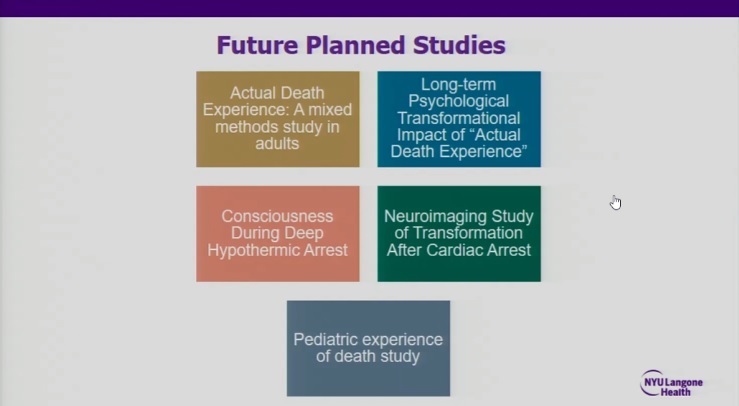
Dr Parnia did refer to a number of new studies that will be starting in the next months and years:

future studies

The one that is of most interest to me is the study looking into consciousness during deep hypothermic arrest. This is effectively COOL II. At this stage they are just performing a pilot study to help inform them on design for a larger landmark study. It looks unlikely we will hear anything from this for a number of years, but this has the potential to produce data more efficiently than AWARE II due to the controlled conditions. Also the prospective study into children’s NDEs will provide interesting insights into the differences that have been previously discussed. This will take a long long time as thankfully children are much less likely to be near death, or actually dead, than adults.

He also presented some data that had been collected from going back over historical interviews from numerous NDEs. This has been done before in various publications in IANDS, but I suspect that his team will apply greater systematic and academic rigor. I wasn’t quite sure where these NDEs were sourced from, but they included a whole host of parameters beyond the simple core elements previously described.

Finally, Dr Parnia did get a bit agitated when describing the impatience of the likes of us! He did look at the camera, and actually said that he was speaking “to the camera”…i.e. some of us. Busted! He was insistent that this research takes a long time, that there are not always enough staff to attend CA events etc. This does not explain why he didn’t refer to the abstracts from the weekend, but we must give him the benefit of the doubt and accept that there are protocols etc that he must follow. He did say that there was more data now, but not that much.

I doubt he does come to this site, but if he does, I hope very much that our enthusiasm/impatience doesn’t in anyway hinder his work, or damage what he is trying to do. If it does in any way, then he must tell me. I would rather dial back on the number of my posts than risk his work. If not, as I suspect is the case given how he is disposed to going on TV and talking about NDEs, then he must recognize that it is only natural for people like ourselves who have a keen interest in his work to be eager to learn as much as we can, and express our frustration at not having all the answers now. As always we wish him the very best in his quest to shed light on the nature of consciousness before and after death.

The evening session was just a panel discussion on what had been presented and what they thought about the various different issues. This was very much focused on the resuscitation medicine side of things and potential ethical implications.

Overall it was enjoyable, but for regulars of this blog, nothing new unfortunately. Now I’m going to bed!

Edited to add the morning after:

While there may have been nothing “new” from the perspective of insights into the recent findings from AWARE II, there were a couple of things that happened in the meetings that have refreshed my perspective.

Firstly there was the testimony of the woman who had received CPR for an hour and the doctors were ready to give up, except one, who took over and carried on. That was 10 years ago and now she is well and living a full productive life due to that doctor and modern techniques. Really rammed home to me what an amazing job the likes of Parnia and his team do.

Secondly was the NDE account described by the ER physician Dr. Tom Aufderheide in the panel session in the evening. That was mind blowing and it reminded me of why I first became hooked on the subject of NDEs. We really don’t NEED the results of AWARE II, we have hundreds, if not thousands, of reliable human testimonies, many of them from health care professionals themselves, that one hundred percent corroborate the validity of the OBE. But more than that they attest to the spiritual nature of humans and our ultimate destiny.

On here, we, I, have become so obsessed with the hit, the smoking gun, and I realised last night that I may have lost my focus on the true wonder of these incredible accounts…they are mind blowing. I don’t need AWARE II. I know from my own experience that there is another reality beyond this life. I have experienced it myself, and through the accounts of others. I know I have a soul inside of me…my brain just sometimes forgets!

Anyway, we will continue to follow developments, but Dr Parnia said to the camera, to us, that we must follow the NYU website for any updates. As much as I respect and admire him, I think I will continue to rely on the great contributors here like Tim, David, Eduardo, Z, Samwise, Chad and others who keep finding things on the web now that might just make it to the NYU website in a years time!


NYU Livestream chat and thoughts

Just thought I’d open a new thread so we can post our “live” thoughts here. I notice there are 32 other people watching…hoping some of them are people from here.

The link in case you don’t have it

livestream link

You will be able to ask questions in the chat section

Post Navigation