Gamma garbage
Firstly, I apologise (not for the first time!) about the long wait between posts. I have been working on my novel and a new non-fiction project. Both are now at copy-editing phase, so hopefully mid Fall will see me put them on Amazon.
Secondly, I apologise for not making this post about psychedelics. It is something that is coming, but requires reviewing a whole number of papers, and so is quite a bit of work. Probably be late August when I get round to it. But for now, this paper really piqued my interest.
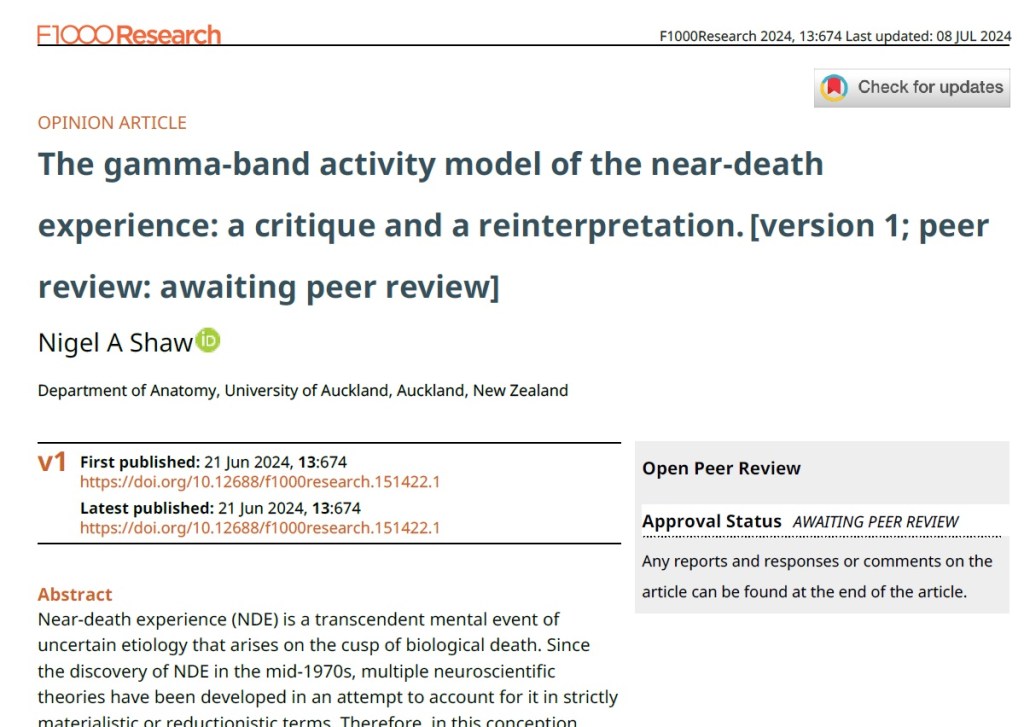
I was sent a link to it by Ian – thank you. It is a comprehensive and detailed review of the evidence relating to the proposition that gamma band activity (GBA) either before CA (peri-CA) in patients or animals in a coma, or up to 30 seconds post CA in rats, and up to an hour post CA in patients receiving CPR, could account for Near Death experiences.
This proposal, that GBA provides evidence that elements of the NDE are generated in the brain, have been most vocally promoted by Borjigin and other materialists. Parnia has repeatedly claimed that the GBA observed in patients undergoing CPR could be associated with an NDE (even if they haven’t been), but unlikely to be the cause. He suggests it is a sign of the consciousness accessing different dimensions. I have already produced countless words here explaining why neither of these claims is with serious foundation. Firstly, there were no reports of conscious recollection in any of the cases where GBA was observed, secondly, even if there were, association is not causation, but since we don’t even have association, the claims are just researchers trying to get attention…it’s what they do.
Anyway, that’s the back story. Something that has never been entirely clear to me in all of this is the “so what” of observing GBA. When you do a bit of research, it is clear that there is a consensus that Gamma activity on an EEG is associated with consciousness. Questions around strength of signal and precisely which wavelengths etc are most closely associated with conscious activity remain unanswered. This paper goes a long way towards answering some of these questions and discounting the idea that these transient episodes of GBA around the time of death could be evidence that the brain is producing the complex narratives that come out of NDEs.
It is a highly detailed paper, and not the easiest to read, however these are the key take-aways I got from it:
1. The link between gamma waves and consciousness, or states of awareness, has not been proven. It is strongly suspected to be the case, but due to the fact that gamma waves are somewhat ubiquitous, it cannot be stated with certainty that they are definitely linked, and less so in what way. For example:
The authors formally analyzed the absolute and relative power of GBA for both wakefulness and ketamine-xylazine anesthesia. For absolute power, little difference could be detected between the conscious and unconscious states for any of the four GBA subbands. Regarding relative power, there was a tendency for activity to increase during the waking period, but only in the medium and higher gamma bands. Such findings do not resolve the relationship between GBA and the level of arousal.
2. Not only has the link between gamma and conscious awareness not been proven, but there is evidence from research into psychedelics and “NDE-like” experiences, that gamma is less prominent:
What was discovered was the dominance of slow delta and theta oscillations was accompanied by a striking loss of spectral power in the faster rhythms. Such findings are, of course, quite contrary to the expectations of the GBA model. Assuming that the high-frequency burst of activity is actually associated with the induction of an NDE, it would be predicted that fast oscillations underlie the action of an agent such as DMT. This is strong implicit evidence that the surge in GBA at the moment of death is unlikely to be responsible for NDE.
3. The anatomical source of GBA around the time of death is not clear, especially post CA. For example, muscles produce gamma waves. Many of these studies claim to account for that, but there are inherent problems with capturing these signals, especially when using electrodes attached to the surface of the scalp. The GBA signals being picked up could be coming from almost anywhere, especially in the absence of other strong signals.
The more the GBA has been contaminated by artifacts, the less likely it is to fulfill its purported role as a kind of neural blueprint for NDE. It is a concern that those who propose a link between GBA and NDE choose to turn a proverbial blind eye to such a potential flaw or weakness in their argument.
This argument applies much less so in the coma patient’s peri-CA. In those patients (who are still alive incidentally – see my last post) the GBA is almost certainly from the brain, but exactly what it relates to is a subject of pure speculation. Moreover, while it is assumed that EEG activity is coming from the cortex, it is possible it is coming from the amygdala, as various experiments have previously shown.
These intermittent oscillatory emissions or signals arise in the basolateral amygdala (BLA) and consist of spindle-like bursts of high-frequency high-amplitude activity, typically lasting from seconds to minutes. They are endogenous but not strictly spontaneous because they can be evoked by a variety of stimuli. These included states of arousal, threat, learning, emotion, fear, stress, anticipation, pain, and noise. It might be predicted therefore, conditions such as hypoxia, ischemia, or cardiac arrest would provide an optimal milieu for the enhancement and/or appearance of the BLA rhythm. Nonetheless, it is in no way implied that these amygdaloid oscillations recorded from the cortex possess any mystical or psychedelic properties and, therefore, could be responsible for the NDE.
This very much echoes what I said in the video I made in the previous post, namely that instinctive and involuntary reactions to a state of hypoxia would probably cause parts of the brain responsible for fright and flight to light up and send signals out to get the body to move and start breathing again. This seems like the most likely explanation for any brain activity. It is desperately trying to resolve the threat. This is classic Ockham’s razor territory, something that the author states in his conclusions:
The present re-interpretation of the significance of the surges in GBA is obviously somewhat routine and quotidian, especially when compared with the more exotic, intriguing, and tantalizing alternative. It is unlikely to attract the same amount of attention from media. Nonetheless, it has the virtue of being parsimonious. As Ockham’s principle reminds us, simplicity is often a useful guide for scientific truth.
I also believe this is the most likely explanation of what we are seeing in Parnia’s CPR patients. Just enough blood is reaching the brain to cause primitive emergency responses to the state it is in.
In summary, the relationship between GBA and conscious awareness has not been fully established, and most definitely not characterised…in other words we cannot be certain that GBA and conscious awareness are linked, and even if we were, we don’t know how. Moreover, there is evidence from psychedelics that GBA is not associated with transcendental experiences with similar characteristics to NDEs. Finally, the anatomical source of the GBA in these studies may not be the cortex, but somewhere else, and more likely physiological in nature rather than of the kind of brain activity that would produce complex memories like NDEs.
So, whenever you hear about GBA being related to NDEs you will now know that the observation is meaningless regarding connection to or explanation of the phenomenon even if there was an associated NDE…which there never has been!
Aiming for an August post about psychedelics 😊

 AwareofAware