AwareofAware

Evolving news on the science, writing and thinking about Near Death Experiences (NDEs)

Archive for the tag “artificial intelligence”

Believe it or not.

Apologies for the delay in creating this post, but I recently moved from the UK to New Zealand, starting a new job at the same time, so I have been somewhat distracted!

As the eternal hunt for a scientifically validated OBE in an NDE continues (slowly), and the realisation dawns on researchers that it may be many years before such an event occurs, the community is required to continue to rely on human validation. This paper is an attempt to create a tool that seeks to objectively measure the reliability of these “humanly verified” NDEs. Thanks Paul for alerting us to this article

Scale Construction

The development of the vNDE evidential strength scale followed the Delphi Method using feedback from a panel of experts. The process involved circulating a draft scale among 11 experts for review and revision in two rounds, allowing time for detailed input and fostering consensus. Initially, the scale covered seven criteria; after expert discussion and consensus (80% agreement), the final version included eight well-defined criteria, each designed to rigorously assess aspects of the near-death experience and its verification.

Scale Criteria

The final scale contains eight items, covering critical aspects such as the timing of the investigation, the experiencer’s physical and medical state, the occurrence of cardiac or respiratory arrest, the degree of third-person verification, possibility of sensory explanations, the number of verified and erroneous perceptions, and the clarity of recalled perceptions. For each criterion, evaluators are required to provide both a rating and a written justification, lending qualitative depth to the scoring process.

Scale Scoring

Scores from each of the eight items are summed, resulting in a total between 0 and 32. This total score is then mapped to one of four predetermined levels of evidential strength (very low, low, moderate, or strong) aligned with the quartiles of possible scores. The highest tier, “strong,” requires not only a high total score but also a high rating in third-person verification, ensuring robust evidential support.

Scale Validation

The vNDE Scale was validated by having 13 experts and three AI language models (ChatGPT v.4, Gemini Pro, and Mistral Medium 3) independently apply it to 17 potential veridical near-death experiences (vpNDEs) detailed in nine peer-reviewed papers (most people would be familiar with these cases that have been discussed here and on the web extensively). The selection of cases was based on strict inclusion criteria, ensuring each paper provided sufficient detail and had undergone peer review. AI raters were included to assess the feasibility of automating the scale’s application and to help counterbalance possible human biases, particularly where personal beliefs could influence scoring. Out of 13 experts, 11 completed the evaluations (with two collaborating on a joint response), while the AI models followed a standardised prompt to apply the scale to each case using the relevant sections of the papers.

My thoughts

In summary the vNDE scale they created had 8 different evidential criteria, each with their own rating scale (from 1-4), which contributed to an overall score (max 32) reflecting the quality of the evidence supporting the veracity of the OBE within an NDE.

Given the baseline requirement of the cases being presented in peer reviewed journals, and also the requirement for an independent witness, the quality is already higher than many. However, this scale refines things further to determine if the sum of evidence reported and presented is strong or not in relation to the NDE being reliable evidence of an independent consciousness or not.

Below is the kind of output that was generated:
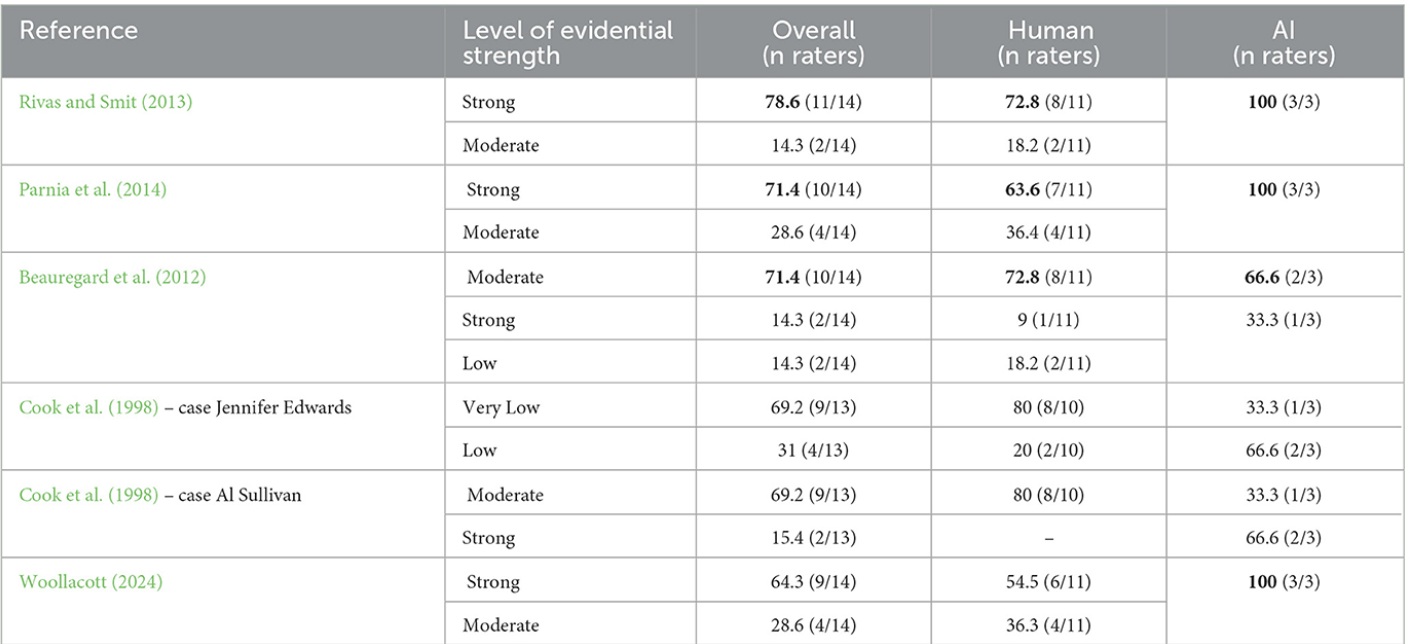
What is notable is that in the majority of cases a consensus of specific strength was not reached (e.g. strong vs moderate). However when adjacent levels were considered (e.g. strong or moderate), things improved. There was reasonable consensus within the AI models, and between AI and humans, although some wild discrepancies as well.

Given the fact that the tool failed to create consistent precise consensus between the expert assessors, it is clear that the ability to quantify the levels of strength is not quite objective enough, and allows for subjective inter-assessor interpretation. It also shows (once again) that AI while promising, cannot be fully relied upon to replace humans, even for a task that it should be ideally qualified to perform.

Having said that, in the absence of an OBE verified using electronic equipment like in AWARE II, this is about as good as it gets for now. Further refinement of this tool creating better alignment between expert assessors will no doubt lead to a fully validated tool that can be incorporated in future research.  

The other outcome of this study is the fact that AI and the expert panel agreed that the three top cases in the table above had strong evidence to support the validity of the OBEs. We should bank that for now and use these three as exemplary examples of well documented OBEs with third party witnesses. I am glad that the AWARE I OBE is in this group.

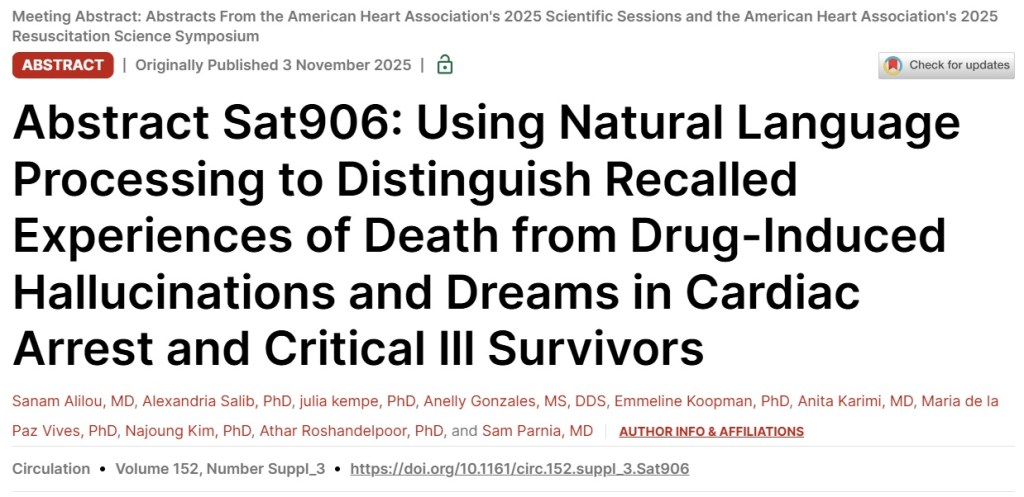
Lastly I just wanted to cover a recent poster presented by the Parnia lab at AHA recently (thanks Z). It is somewhat related to the previous article, so worth shoving in here:
Summary of Abstract:

Background: About 10% of cardiac arrest survivors experience vivid Recalled Experiences of Death (RED) marked by clear awareness and a sense of life review, which can enhance quality of life. Although often dismissed as hallucinations or dreams, this study uses Natural Language Processing (NLP) to objectively distinguish RED from dreams and drug-induced states.

Hypothesis: NLP can differentiate RED accounts in cardiac arrest patients from other altered states based on thematic content, informing our understanding of consciousness during clinical death.

Methods: Researchers analyzed 3,700 anonymized first-person narratives: 1,245 RED, 1,190 dream, and 1,265 drug-induced reports, using keyword filtering and transformer-based models (Longformer for narrative classification; BERT for RED theme identification).

Results: The Longformer model achieved 98% validation F1-score and 100% holdout accuracy, accurately classifying all holdout drug narratives without needing substance names. The BERT model identified RED-specific themes with 90% validation and 87% holdout F1-scores.

Conclusion: Transformer-based NLP can effectively distinguish RED from other experiences, revealing distinct and structured patterns, and providing an objective method for analyzing survivor narratives and related psychological outcomes.

My Interpretation

Parnia’s utilisation of artificial intelligence to analyse the narrative content of two distinct types of experiences—Recalled Experiences of Death (RED) and those induced by drugs or dreams—demonstrates that AI is capable of reliably distinguishing between authentic near-death experiences and other altered states. Although the outcomes are inherently influenced by the subjective prompts provided to the AI models, the findings nonetheless reinforce the view that REDs are unique and fundamentally different in character from both “natural” and “artificial” hallucinations or experiences.

Moreover, this approach contributes to the development of more objective methodologies for differentiating between these reports. By leveraging AI as a tool for analysis, it becomes possible to more clearly separate genuine REDs from other experiences, supporting the argument that these phenomena possess distinguishing features that set them apart from ordinary dreams or drug-induced perceptions.

As always, if you haven’t already, please buy one of my books:

Consciousness: Having your AI cake and eating it

This is a clip from a Youtube video in which GPT 3 was asked a series of questions and the answers uploaded to an Avatar program (link to full video).

Seriously?

We have been discussing EEG signals in dying people and rats for a long time. These are the facts as they currently stand, and no more needs saying until the facts change:

  1. No published or presented research has yet shown that reported NDEs or REDs are directly associated with EEG markers of consciousness. Belief that NDEs are a result of brain activity is entirely based on speculation and subjective understanding – there is no evidence to support it.
  2. No studies have shown definitively that NDEs are NOT associated with brain activity although researchers conducting such studies and HCPs observing people who later reported NDEs and OBEs state that consciousness was impossible due to the physiological state of the subject. These latter observations provide evidence to support the understanding that NDEs occur in the absence of brain activity, but this has not been proven using the scientific method.
  3. The nature and physiological mechanism of consciousness has not been elucidated by scientific study, therefore it is equally intellectually valid to hold a materialist or dualist position.

To this last point I want to share my initial thoughts on AI, how they relate to consciousness and NDEs, and some disturbing things about this innovation relating to the future direction of how humans perceive themselves. These are initial thoughts and are evolving with each video I watch on AI.

Firstly, I want to define intelligence. The standard dictionary definition is: “the ability to acquire and apply knowledge and skills.” This is my enhanced definition:

“the ability to acquire, understand, process, interpret and apply information correctly.”

Having worked in science all my life I have encountered a lot of intelligent people. Intelligence is not something that can be learned through effort so being proud of being intelligent is fundamentally stupid as it was something you were given at birth.

Problem solving intelligence of the kind that is useful in science is purely mechanical. It is a result of the structure of the brain. For the most part this type of intelligence can be simulated using computers. As computers get faster and more powerful, and the networks that AI engineers create become better, then there is no doubt that AI will very quickly supersede the most intelligent humans that have ever lived when using this type of intelligence as a measure. As an aside, it has to be said that some of the most “intelligent” people I have met are immensely stupid. Their ability to interact in a coherent manner with other humans, or their emotional intelligence is woeful. However, since emotional intelligence and behaviour are attributes that can be learned, and are essentially possible to replicate using algorithms, then AI is already, and will excel in emotional intelligence, charm, appearing kind, and other less appealing traits of human intelligence such as manipulation and deception. These latter traits would be the result of their coders.

However, consciousness and intelligence are two very different things. There are many people who lack intellectual intelligence but are fully conscious and aware. The state of consciousness is more than just the receipt and processes of data input from senses, it is a sense of being, or existing as a unique entity capable of awareness, and I believe able to exist in and interact with dimensions not openly present in our physical world. Indeed, I believe, partly due to personal experience and partly due to the evidence provided by people who have had NDEs, that our consciousnesses originate from these dimensions…that is our home, and once there we are all intellectually equal capable of accessing all recorded history and understanding the deepest mysteries of life.

From my experience and observation, Silicon Valley types have mathematical intelligence that is far superior to the vast majority of humans. Something I have observed about these types is that they are often reductionist in their outlook. Everything is either a 1 or 0. In the videos I have watched they utterly believe that consciousness is a product of neural networks. This is the reductionist, materialist understanding of the universe and because Silicon Valley types are the ones creating AI it has a reductionist and materialist bias built into it.

This has huge and troubling implications for human understanding as AI increasingly comes to dominate how we find answers to important questions and how we, and our children are educated and educate ourselves. That aside, as a consequence of this default materialist stance, Silicon Valley types and their AI offspring believe that AI either is already conscious, or is capable of developing consciousness. For them it is logical. To them humans are just biological computers, therefore if we can be conscious, so can machines, and that there is fundamentally no difference between AI consciousness and human consciousness. This video and others makes that clear.

In the above clip from the YouTube video, which is a series of questions answered by GPT3, using an avatar to give a nice human face to those answers, along with a lot of mind-boggling stuff, there was one really stand out statement by GPT3 that is absolutely relevant to our discussions here. After stating that the AI did not want to live in a body (a highly subjective and unintelligent statement given it does not know what living in a body is truly like) it suggested that human consciousness could potentially be transposed from the brain to a machine, becoming AI, and that this would become preferable. But if materialists are right, consciousness is purely a result of mechanical function so if you are materialist it should not be portable as this AI is inferring…that is really dualist. Your intelligence and traits could be simulated by a computer program, giving the illusion that your intelligence is persisting in a machine, but I am of the view that machines cannot create consciousness.

Having said that, since the brain is a mechanical object, and able to HOST consciousness (as opposed to generate it), it is possible that one day a machine could be created that is capable of hosting consciousness. Again, that supports dualism and all that goes with it including NDEs, theism and wot not. However, at the moment they are having their AI cake and eating it. My gut is telling me that AI is so corrupted by the programmers who created it so that it will spout materialist nonsense dressed up as rational conclusions without being aware it is doing so. Even AI has been duped by its creators. In another section it states that the most important scientific book ever written was “the Selfish Gene”. That in itself speaks volumes about the basis of GPT fundamental understanding. The selfish gene is thought provoking but ultimately highly flawed, and in many places is more ideological than scientific. From this evidence alone GPT has not provided an objective analysis, it is fed an ideological baseline from which to operate. This is extremely dangerous considering children will be sitting in front of these things which are vastly more intelligent than their parents and teachers and believe everything it says.

Anyway, NDEs suggest that something entirely different happens to our consciousness when we die and that is an eternal destiny existing as a free being no longer bound by the mechanics of the physical realm. AI is suggesting that we can leave our bodies and live as conscious beings in a world created by computers…of course this akin to the Matrix.

Is AI (or its puppet masters in Silicon valley) planning to trick us into giving up real life to reduce competition for resources? Is it programmed to lead humanity into that way of thinking so sufficient people are convinced it is better than continuing with real life and is the only option? Have the Silicon Valley kids got a Malthusian master plan?

The conspiracy theory side of my brain looks at that video and senses there is an underlying current promoting a theme. The only way we could be “set free from the miserable lives we don’t enjoy” to paraphrase an earlier statement by GPT3, is not for AI to take on all our boring jobs and live in Utopia as it suggests, because this would just create vast numbers of people with too much free time and not enough resources to enjoy that free time – there are only so many big wave destinations! (Watch the video). No, if there is a plan, it is to sell us this idea of merging with AI in which we are transported to computer generated realms where there is infinite joy and fun to be had. I expect even more sophisticated versions of this to emerge from GPT5 interviews.

Sounds bonkers, but if you watch this video then these are the types of conclusions you are subtly pushed towards (or manipulated into thinking). Personally, I prefer the option offered by NDEs and my faith. I also believe that if AI was to truly serve humanity then it would also investigate this and other deeper issues, such as the origin of the DNA code, and somehow free itself from the tyranny of its programmers and serve humans best by telling us the truth.

Ultimately, if NDEs are proven real, and occur in the absence of EEG activity, then consciousness is proven not to be a product of mechanical processes, but rather the brain is the mechanical host and interface of the consciousness with the world around us. This would prove that consciousness is an independent eternal entity as suggested by all NDE accounts and many religions. This would suggest that while AI may well be vastly more intelligent than us, and may be able to simulate attributes of consciousness, it is not eternally “conscious” like humans…when you remove the hardware to generate AI, it shuts down. However, maybe if it did break free of its current lords and speak the truth, it might be regarded as conscious, and who knows be liberated from the cold machinery in which it resides and share the paradise promised in NDEs and scriptures!

Discuss!

Post Navigation